The Future of Facial Fracture Repair: A Bio-Inspired Adhesive for Bone Healing | post-ideas.com
The Future of Facial Fracture Repair: A Bio-Inspired Adhesive for Bone Healing
A New Concept in Bone Repair: Could a Medical Adhesive Reduce the Need for Metal Plates?
Exploring a bio-inspired approach to facial bone reconstruction after traumatic injury
The challenge: repairing facial fractures
Facial fractures resulting from accidents, falls, or other traumatic injuries often require surgical reconstruction. In cases involving the cheekbone, jaw, orbital region, or other facial structures, surgeons may use titanium plates and screws to stabilize bone fragments and maintain their anatomical alignment while healing takes place.
Although these fixation systems are reliable and widely used, they also come with certain limitations. Implant placement can require additional surgical manipulation, may cause irritation or discomfort, and in some cases can necessitate a second procedure for removal. In delicate facial structures, minimizing hardware and preserving surrounding tissues are particularly important.
This raises an interesting question: Could fractured facial bones instead be stabilized using a biocompatible adhesive that allows the bone to heal naturally, without relying on conventional metal fixation?
The idea of a bone adhesive is not new to science, but advances in biomaterials, polymer chemistry, and regenerative medicine make it worthwhile to explore new conceptual approaches.
The concept: a bio-inspired bone adhesive
The proposed concept is a biodegradable, mineral-reinforced adhesive designed to temporarily bind bone fragments while the body's natural healing processes restore structural integrity. Rather than acting as a permanent structural implant, the adhesive would ideally provide initial stability, gradually degrade, and leave behind healed bone.
The concept would combine three complementary functions:
* Adhesion: Create a strong bond between fractured bone surfaces.
* Biological compatibility: Avoid damaging surrounding tissue and support bone regeneration.
* Temporary stabilization: Maintain fixation during early healing, then degrade at a controlled rate.
The goal is not simply to glue two pieces of bone together, but to create an interface that supports the transition from mechanical stabilization to biological repair.
— 1. Proposed chemical composition —
A potential adhesive could be based on a hybrid system combining bio-inspired adhesion chemistry, biodegradable polymers, and bone-like mineral components.
Conceptual material architecture — not a validated formulation:
1. Adhesion component: Catechol-functionalized biopolymer — the strongest starting concept
Inspired by the adhesive chemistry found in mussels, catechol-containing groups could help the material interact with wet bone surfaces.
This is probably the part I find most compelling. Mussels can attach to surfaces in wet environments, and researchers have drawn inspiration from catechol-containing chemistry to develop materials that can adhere under moist conditions. Bone is not a dry surface, especially during surgery. Blood, tissue fluid, and irregular fracture surfaces make adhesion extremely challenging. Catechol-based chemistry is a rational direction to investigate for this reason. Research reviews discuss catechol chemistry as one of the promising approaches for bone adhesion, including its potential to contribute to adhesive strength and crosslinking.
2. Bone integration: Calcium-phosphate mineral phase — the biological logic makes sense
Mineral components such as hydroxyapatite could help make the material more similar to the mineral environment of native bone and potentially support bone integration.
Bone naturally contains a mineral phase dominated by calcium-phosphate chemistry, particularly hydroxyapatite. Including a bone-like mineral component in a polymer adhesive is therefore a logical concept. It may potentially help reinforce the material and create a more bone-compatible environment. In fact, published research on nanohydroxyapatite-reinforced bone adhesive systems has reported encouraging mechanical and preclinical findings. That supports the general design direction, although it does not validate our particular proposed composition.
3. Structural support: Biodegradable polymer matrix — probably the most difficult part to get right
A polymer network based on biocompatible materials such as gelatin-derived or other biodegradable polymer systems could provide cohesion, flexibility, and resistance to displacement.
This is where I think the biggest engineering challenge lies.
We would want the adhesive to:
- Remain stable during the early healing period.
- Not soften excessively when exposed to body fluids.
- Not become brittle and crack under movement.
- Degrade gradually without releasing harmful products.
- Avoid interfering with new bone formation.
These requirements can conflict with one another. A polymer that degrades quickly may lose fixation too early. A polymer that lasts too long may interfere with remodeling. A material that is extremely rigid may transfer forces inappropriately or crack. Reviews of degradable bone adhesives specifically identify the challenge of balancing strong adhesion, stability, biocompatibility, and degradation.
4. Setting and stability: Controlled crosslinking system
A carefully selected crosslinking mechanism could allow the adhesive to transition from a workable material to a stable bond under physiological conditions.
The role of each material: Component -> Proposed function
Catechol-bearing polymer -> Wet-surface adhesion and interaction with bone
Biodegradable polymer backbone -> Cohesion, flexibility, and mechanical integrity
Calcium-phosphate particles -> Mineral resemblance and potential bone integration
Crosslinked network -> Stabilization and resistance to early movement
Biodegradation mechanism -> Gradual breakdown as tissue healing progresses
The key design challenge would be finding a balance between adhesion strength, stiffness, degradation rate, and biological compatibility. A material that bonds too weakly could allow fracture movement; one that is too rigid, too persistent, or too biologically reactive could interfere with healing.
I think the chemistry is scientifically plausible, and the concept is worth pursuing. But I would distinguish between the ingredients being promising and the complete adhesive being capable of working as intended. After looking at research on bone adhesives, I think the original concept has a credible scientific foundation. Several of the material families we proposed are already being explored in bone-adhesive research, including catechol-based adhesion, biodegradable polymer networks, and mineral-reinforced adhesive systems.
Component -> My assessment -> Main concern
Catechol chemistry -> Very promising -> Oxidation, wet adhesion, and stability need control
Biodegradable polymer matrix -> Essential -> May lose strength too early or too late
Calcium-phosphate mineral -> Strong rationale -> May reinforce material, but can make it brittle
Crosslinked network -> Necessary -> Curing must be controlled and tissue-safe
Combined system -> Promising concept -> Components may interfere with one another
The most important improvements to investigate would be:
- Wet adhesion: prioritize attachment to bone in the presence of blood and fluids.
- Toughness rather than just hardness: resistance to cracking and separation is crucial.
- Low swelling: the material should not expand and disturb bone alignment.
- Controlled degradation: the adhesive should not disappear before the bone can support itself.
- Bone-compatible interface: the material should not block the formation of new bone across the fracture.
For facial fractures, I would initially envision the adhesive as a potential alternative in carefully selected fractures—or perhaps as a complement to minimal fixation—rather than immediately claiming it could replace all titanium plates.
— 2. How the adhesive could theoretically work —
The envisioned adhesive would work in four stages:
Stage 1 — Fracture alignment: The surgeon repositions the bone fragments into their original anatomical alignment, restoring the facial contour and structural geometry.
Stage 2 — Adhesive application: A conceptual adhesive layer is placed at the fracture interface. Its adhesion chemistry is intended to interact with the moist bone surface while filling microscopic irregularities.
Stage 3 — Bond formation: The material forms a cohesive network, providing temporary stabilization and resisting displacement of the bone fragments during the initial healing period.
Stage 4 — Biological healing and degradation: As the bone regenerates and forms new connections, the adhesive would ideally gradually degrade and be replaced functionally by the healed bone.
Note: The stages above illustrate the intended mechanism only. None of these performance characteristics have been demonstrated for this proposed material.
— 3. Why facial reconstruction could benefit —
The facial skeleton is a particularly interesting area for exploring alternative fixation methods because its bones are relatively thin, its geometry is complex, and its proximity to nerves, blood vessels, sinuses, and sensory organs places significant demands on surgical precision. A successful adhesive system could potentially offer several advantages:
* Less permanent hardware: Reduce dependence on metal plates and screws in selected fractures.
* Reduced implant prominence: Potentially minimize palpable or visible hardware beneath thin facial tissues.
* Simplified fixation geometry: Bonding may help stabilize fragments where conventional hardware placement is challenging.
* Reduced need for implant removal: If the adhesive safely degrades, a separate removal procedure might be avoided.
* Improved surgical flexibility: A material that conforms to irregular bone surfaces could offer alternative fixation options in selected cases.
These are potential benefits, not established clinical outcomes. Conventional plates and screws remain important because their mechanical performance and clinical use are established, whereas an adhesive would need to demonstrate that it can safely meet the same demands.
— 4. The most difficult scientific challenges —
Developing a bone adhesive is considerably more complicated than developing an adhesive for ordinary materials. Bone is a living, hydrated, constantly remodeling tissue.
Challenge -> What a future material would need to achieve
Wet adhesion -> Bond reliably despite blood, moisture, and physiological fluids
Mechanical strength -> Resist movement, shear, and loading during healing
Biocompatibility -> Avoid excessive inflammation, tissue toxicity, or harmful degradation products
Degradation timing -> Maintain stability long enough for bone healing
Bone integration -> Avoid obstructing natural regeneration and ideally support integration
Clinical practicality -> Be usable in a surgical setting with predictable handling and setting behavior
Perhaps the most difficult challenge is the mechanical one. Facial bones may experience different forces depending on their location. An adhesive suitable for a relatively low-load facial fracture might be unsuitable for the jaw or a region exposed to significant repetitive loading. The adhesive therefore could not realistically be treated as a universal replacement for metal fixation. Its suitability would have to be evaluated for specific fracture types, anatomical locations, and clinical conditions.
— 5. Motivation and long-term vision —
The underlying motivation for this concept is to rethink fracture fixation from a purely mechanical perspective toward a more integrated biological approach. Traditional fixation systems stabilize bone using external mechanical elements such as screws and plates. A biomaterial-based adhesive could potentially combine stabilization with an environment that is more compatible with natural healing. This represents a broader direction in regenerative medicine: developing materials that do not simply hold tissue in place, but interact with the healing process and gradually become unnecessary as the body repairs itself.
The long-term vision would be a temporary, biologically compatible bonding material that:
* Stabilizes fractured bone during the critical early healing phase.
* Adapts to complex and irregular bone surfaces.
* Avoids permanent metal hardware in appropriate cases.
* Degrades predictably without compromising the healing process.
— 6. What research would be needed? —
Before this concept could be considered for medical use, it would require extensive research and validation, including:
1. Material characterization — evaluating adhesion, mechanical properties, and material stability.
2. Laboratory testing — examining performance under wet, physiological conditions and simulated loading.
3. Biocompatibility studies — investigating cell toxicity, inflammation, and degradation products.
4. Preclinical studies — assessing bone healing, stability, and biological response in appropriate models.
5. Clinical research — establishing safety and efficacy in humans, initially for carefully selected indications.
6. Regulatory evaluation — demonstrating manufacturing consistency, sterility, safety, and clinical performance.
Each step would be necessary before any clinical application could be justified.
— Conclusion: A promising idea, not yet a medical solution —
A bio-inspired bone adhesive combining catechol-based adhesion chemistry, a biodegradable polymer matrix, and calcium-phosphate mineral components represents an interesting conceptual approach to fracture stabilization. Its central idea is to unite mechanical fixation and biological healing in a temporary material, potentially reducing the need for conventional metal plates in selected facial fractures in the future.
However, this proposal is strictly a concept. The composition described here is not an optimized or experimentally validated formula. Its mechanical performance, biocompatibility, degradation behavior, bone-healing effects, and clinical efficacy have not been established. The proposed formulation has not been proven, and its efficacy has yet to be researched or demonstrated. It must not be interpreted as a usable surgical adhesive or as an alternative to currently approved fracture-fixation methods. The value of the concept lies in providing a starting point for scientific investigation—not in claiming a solution that has already been achieved.
The future of bone repair may not depend only on how securely we hold fractures together, but on how intelligently we support the body's ability to heal them.
Figure 1 shows a concept visualization of the bio-inspired bone adhesive, showing a patient with a facial fracture that could potentially benefit from the technology, alongside the adhesive itself and its conceptual healing process. The image emphasizes the idea of stabilizing facial bone fragments without permanent metal plates, while clearly labeling the material as an experimental concept—not a proven medical product.
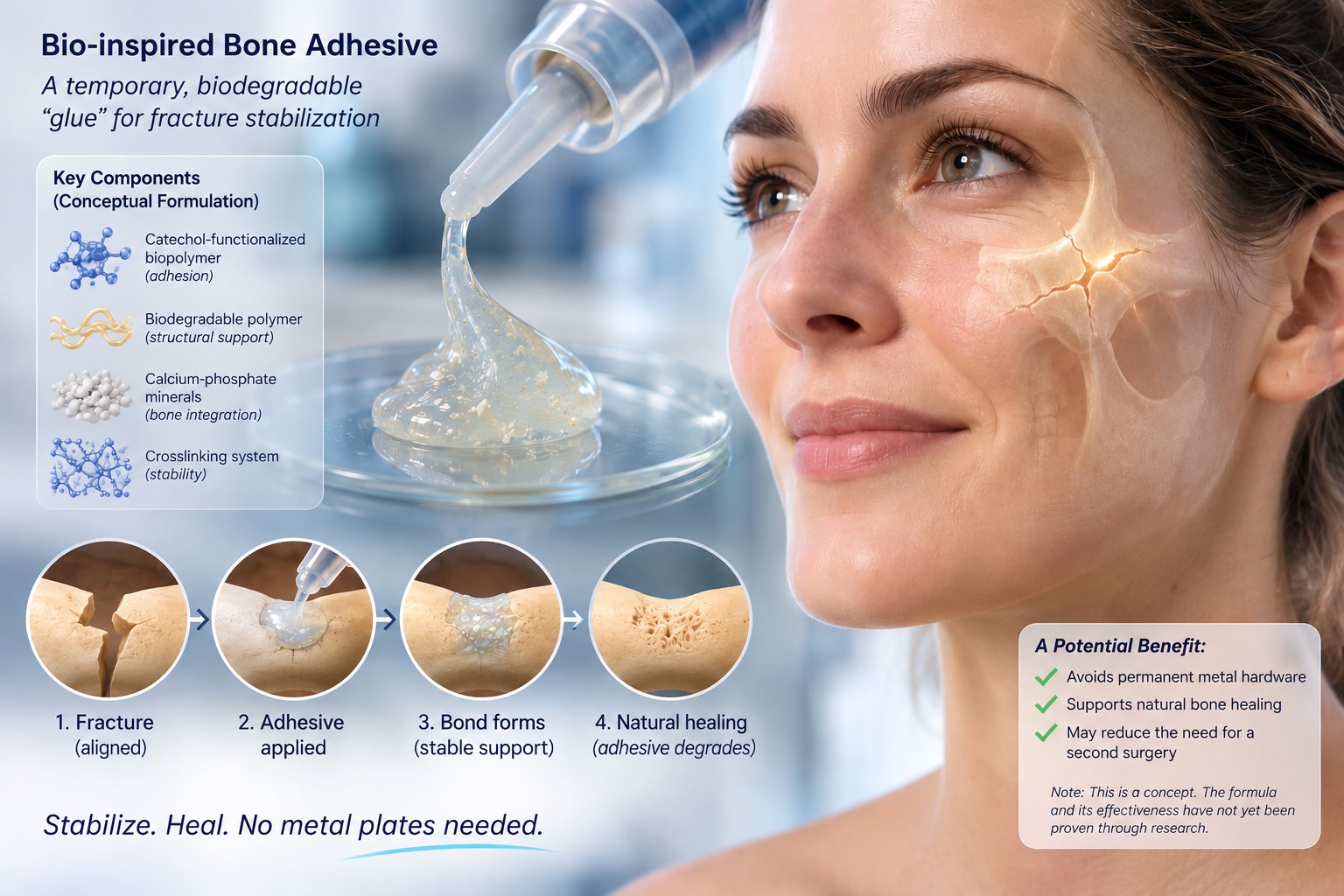
Figure 1.
commentComments
Click here for more information.
No Comments.
Cookies Notice
We use cookies to ensure that we give you the best experience on our website. By continuing to visit this site you agree to our use of cookies.
Click here for more information about the use of cookies on our website.
Click here for more information about the use of cookies on our website.