Eco-friendly bike tires to reduce harmful microplastic emissions | post-ideas.com
Eco-friendly bike tires to reduce harmful microplastic emissions
Reducing microplastic emissions from bicycle tires is a realistic and high-impact sustainability project. Bicycle tires shed far less material than car tires, but widespread cycling adoption means there’s still an opportunity to create a cleaner alternative that also becomes a differentiator for urban mobility brands.
Here is why bike tires emit microplastics. Conventional bicycle tires typically contain synthetic rubbers such as styrene-butadiene rubber (SBR), petroleum-derived fillers, carbon black, and chemical softeners and stabilizers.
As the tire abrades against pavement, tiny particles are released into road dust, stormwater systems, soil and waterways, and indoor air (especially for trainers and indoor cycling).
So the challenge is to reduce abrasion without sacrificing the grip, rolling resistance, durability, cost, and puncture resistance.
---
> Core Design Strategy: The best approach is not a single material swap. It’s a systems redesign.
1. Replace Persistent Petrochemical Elastomers
Candidate Materials:
- Natural rubber (Benefit: Renewable, elastic, lower fossil content / Challenge: Wear resistance tuning needed)
- Guayule rubber (Benefit: Lower allergen risk, drought tolerant / Challenge: Scaling supply)
- Dandelion rubber (Benefit: Temperate-climate cultivation / Challenge: Early-stage commercialization)
- Bio-based polyurethane elastomers (Benefit: Tunable properties / Challenge: Compostability varies)
- Thermoplastic elastomers (bio-TPEs) (Benefit: Recyclable / Challenge: Heat performance)
Promising Blend -> A hybrid tread compound:
- 50–70% natural or guayule rubber
- Bio-based elastomer modifiers
- Reduced synthetic SBR fraction
This can significantly reduce persistent polymer shedding.
---
2. Replace Carbon Black Fillers
Traditional carbon black improves wear resistance but is fossil-derived.
Alternatives: Filler:
- Silica (Advantage: Lower rolling resistance)
- Cellulose nanofibers (Advantage: Renewable reinforcement)
- Lignin-based fillers (Advantage: Biomass-derived)
- Rice husk silica (Advantage: Agricultural waste reuse)
- Biochar (Advantage: Carbon-negative potential)
>> Strong Candidate is silica + cellulose nanofiber composite because it improves abrasion resistance, reduces particle fragmentation and maintains flexibility.
---
3. Engineer “Benign Wear Particles”
The key innovation: Even if particles are shed, make them environmentally safer.
* Goal: The particles should biodegrade in soil/water, avoid toxic additives, avoid persistent synthetic polymers ans aggregate rather than disperse.
* Design Techniques: use hydrolysable polymer chains, introduce biodegradable crosslinkers and avoid fluorinated additives and zinc-heavy curing systems.
---
* Tread Engineering
Material alone is insufficient. It needs a low-shed tread geometry.
Concepts:
- Larger tread blocks reduce fragmentation
- Rounded transition edges reduce tearing
- Multi-density tread layers:
- Hard outer skin
- Softer internal damping layer
>> Urban Tire Optimization: Most commuter tires can prioritize long wear, low debris generation and moderate grip instead of aggressive race-level traction.
---
* Capture and Containment Concepts
Option A: Sacrificial Wear Film
A thin replaceable outer tread sleeve: peel-and-replace design & collected and recycled.
Could work especially for: cargo bikes and shared mobility fleets.
---
Option B: Electrostatic Particle Capture
A futuristic concept: wheel-integrated static collectors & capture charged tire particles near the wheel well.
More viable for enclosed cargo bikes or e-bikes.
---
* Manufacturing Innovations
Devulcanizable Tires: design tires for circular recovery.
Methods: thermoplastic vulcanizates, reversible crosslink chemistry and microwave devulcanization compatibility.
This enables: tire remanufacturing, closed-loop recycling and reduced virgin polymer demand.
---
* Testing Framework
What needs to be measured:
Metric:
- Abrasion rate (Method: Drum wear testing)
- Particle size distribution (Method: Laser diffraction)
- Biodegradation (Method: OECD soil/water tests)
- Toxicity (Method: Aquatic ecotoxicology)
- Rolling resistance (Method: ISO bicycle tire tests)
- Grip (Method: Wet traction testing)
---
* Most Promising Near-Term Product
A commercially feasible eco-tire in the next 3–5 years would likely include: “Generation 1 Sustainable Urban Tire”
- Natural rubber + bio-elastomer blend
- Silica/cellulose reinforcement
- Zinc-reduced curing chemistry
- Long-life commuter tread
- Retreadable casing
- Fully recyclable bead and casing materials
This could likely reduce:
- Persistent microplastic shedding by 40–70%
- Fossil-derived content by 50%+
- Lifecycle CO₂ footprint substantially
while keeping performance competitive for: city bikes, e-bikes, bike-share fleets and cargo bikes.
---
* Strong Commercial Angles
Best Early Markets:
1. Municipal bike-share systems
2. E-bike manufacturers
3. Sustainability-focused cycling brands
4. Corporate mobility fleets
5. Premium commuter cycling
---
* Research Directions With High Potential
Most promising areas:
- Self-healing tread compounds
- Biodegradable elastomer nanocomposites
- Low-shear tread architectures
- Enzyme-degradable polymers
- Non-toxic vulcanization chemistry
---
* A Practical Prototype Roadmap
Phase 1 — Materials: Develop and benchmark natural rubber blends, bio-fillers and abrasion resistance.
Phase 2 — Tire Architecture: Optimize tread geometry, layering and wear patterns.
Phase 3 — Environmental Validation: Measure real-world shedding, biodegradation and water toxicity.
Phase 4 — Fleet Trials: Pilot with bike-share operators, urban delivery fleets and universities.
---
* Potential Collaborators
You’d likely want expertise from:
- Polymer chemistry
- Tire engineering
- Environmental toxicology
- Urban mobility
- Materials science
Good collaboration targets include:
- Cycling brands
- Sustainable materials startups
- University polymer labs
- Municipal transportation agencies
---
* Key Technical Challenge
The hardest problem is durable tires are usually less biodegradable, while biodegradable materials often wear faster.
The winning solution will balance:
- Controlled biodegradability
- High abrasion resistance
- Low rolling resistance
- Manufacturability
- Cost competitiveness
That balance — rather than full biodegradability — is probably the real breakthrough target.
Figure 1 shows a 3D model of these eco-friendly bike tires.
Here is why bike tires emit microplastics. Conventional bicycle tires typically contain synthetic rubbers such as styrene-butadiene rubber (SBR), petroleum-derived fillers, carbon black, and chemical softeners and stabilizers.
As the tire abrades against pavement, tiny particles are released into road dust, stormwater systems, soil and waterways, and indoor air (especially for trainers and indoor cycling).
So the challenge is to reduce abrasion without sacrificing the grip, rolling resistance, durability, cost, and puncture resistance.
---
> Core Design Strategy: The best approach is not a single material swap. It’s a systems redesign.
1. Replace Persistent Petrochemical Elastomers
Candidate Materials:
- Natural rubber (Benefit: Renewable, elastic, lower fossil content / Challenge: Wear resistance tuning needed)
- Guayule rubber (Benefit: Lower allergen risk, drought tolerant / Challenge: Scaling supply)
- Dandelion rubber (Benefit: Temperate-climate cultivation / Challenge: Early-stage commercialization)
- Bio-based polyurethane elastomers (Benefit: Tunable properties / Challenge: Compostability varies)
- Thermoplastic elastomers (bio-TPEs) (Benefit: Recyclable / Challenge: Heat performance)
Promising Blend -> A hybrid tread compound:
- 50–70% natural or guayule rubber
- Bio-based elastomer modifiers
- Reduced synthetic SBR fraction
This can significantly reduce persistent polymer shedding.
---
2. Replace Carbon Black Fillers
Traditional carbon black improves wear resistance but is fossil-derived.
Alternatives: Filler:
- Silica (Advantage: Lower rolling resistance)
- Cellulose nanofibers (Advantage: Renewable reinforcement)
- Lignin-based fillers (Advantage: Biomass-derived)
- Rice husk silica (Advantage: Agricultural waste reuse)
- Biochar (Advantage: Carbon-negative potential)
>> Strong Candidate is silica + cellulose nanofiber composite because it improves abrasion resistance, reduces particle fragmentation and maintains flexibility.
---
3. Engineer “Benign Wear Particles”
The key innovation: Even if particles are shed, make them environmentally safer.
* Goal: The particles should biodegrade in soil/water, avoid toxic additives, avoid persistent synthetic polymers ans aggregate rather than disperse.
* Design Techniques: use hydrolysable polymer chains, introduce biodegradable crosslinkers and avoid fluorinated additives and zinc-heavy curing systems.
---
* Tread Engineering
Material alone is insufficient. It needs a low-shed tread geometry.
Concepts:
- Larger tread blocks reduce fragmentation
- Rounded transition edges reduce tearing
- Multi-density tread layers:
- Hard outer skin
- Softer internal damping layer
>> Urban Tire Optimization: Most commuter tires can prioritize long wear, low debris generation and moderate grip instead of aggressive race-level traction.
---
* Capture and Containment Concepts
Option A: Sacrificial Wear Film
A thin replaceable outer tread sleeve: peel-and-replace design & collected and recycled.
Could work especially for: cargo bikes and shared mobility fleets.
---
Option B: Electrostatic Particle Capture
A futuristic concept: wheel-integrated static collectors & capture charged tire particles near the wheel well.
More viable for enclosed cargo bikes or e-bikes.
---
* Manufacturing Innovations
Devulcanizable Tires: design tires for circular recovery.
Methods: thermoplastic vulcanizates, reversible crosslink chemistry and microwave devulcanization compatibility.
This enables: tire remanufacturing, closed-loop recycling and reduced virgin polymer demand.
---
* Testing Framework
What needs to be measured:
Metric:
- Abrasion rate (Method: Drum wear testing)
- Particle size distribution (Method: Laser diffraction)
- Biodegradation (Method: OECD soil/water tests)
- Toxicity (Method: Aquatic ecotoxicology)
- Rolling resistance (Method: ISO bicycle tire tests)
- Grip (Method: Wet traction testing)
---
* Most Promising Near-Term Product
A commercially feasible eco-tire in the next 3–5 years would likely include: “Generation 1 Sustainable Urban Tire”
- Natural rubber + bio-elastomer blend
- Silica/cellulose reinforcement
- Zinc-reduced curing chemistry
- Long-life commuter tread
- Retreadable casing
- Fully recyclable bead and casing materials
This could likely reduce:
- Persistent microplastic shedding by 40–70%
- Fossil-derived content by 50%+
- Lifecycle CO₂ footprint substantially
while keeping performance competitive for: city bikes, e-bikes, bike-share fleets and cargo bikes.
---
* Strong Commercial Angles
Best Early Markets:
1. Municipal bike-share systems
2. E-bike manufacturers
3. Sustainability-focused cycling brands
4. Corporate mobility fleets
5. Premium commuter cycling
---
* Research Directions With High Potential
Most promising areas:
- Self-healing tread compounds
- Biodegradable elastomer nanocomposites
- Low-shear tread architectures
- Enzyme-degradable polymers
- Non-toxic vulcanization chemistry
---
* A Practical Prototype Roadmap
Phase 1 — Materials: Develop and benchmark natural rubber blends, bio-fillers and abrasion resistance.
Phase 2 — Tire Architecture: Optimize tread geometry, layering and wear patterns.
Phase 3 — Environmental Validation: Measure real-world shedding, biodegradation and water toxicity.
Phase 4 — Fleet Trials: Pilot with bike-share operators, urban delivery fleets and universities.
---
* Potential Collaborators
You’d likely want expertise from:
- Polymer chemistry
- Tire engineering
- Environmental toxicology
- Urban mobility
- Materials science
Good collaboration targets include:
- Cycling brands
- Sustainable materials startups
- University polymer labs
- Municipal transportation agencies
---
* Key Technical Challenge
The hardest problem is durable tires are usually less biodegradable, while biodegradable materials often wear faster.
The winning solution will balance:
- Controlled biodegradability
- High abrasion resistance
- Low rolling resistance
- Manufacturability
- Cost competitiveness
That balance — rather than full biodegradability — is probably the real breakthrough target.
Figure 1 shows a 3D model of these eco-friendly bike tires.
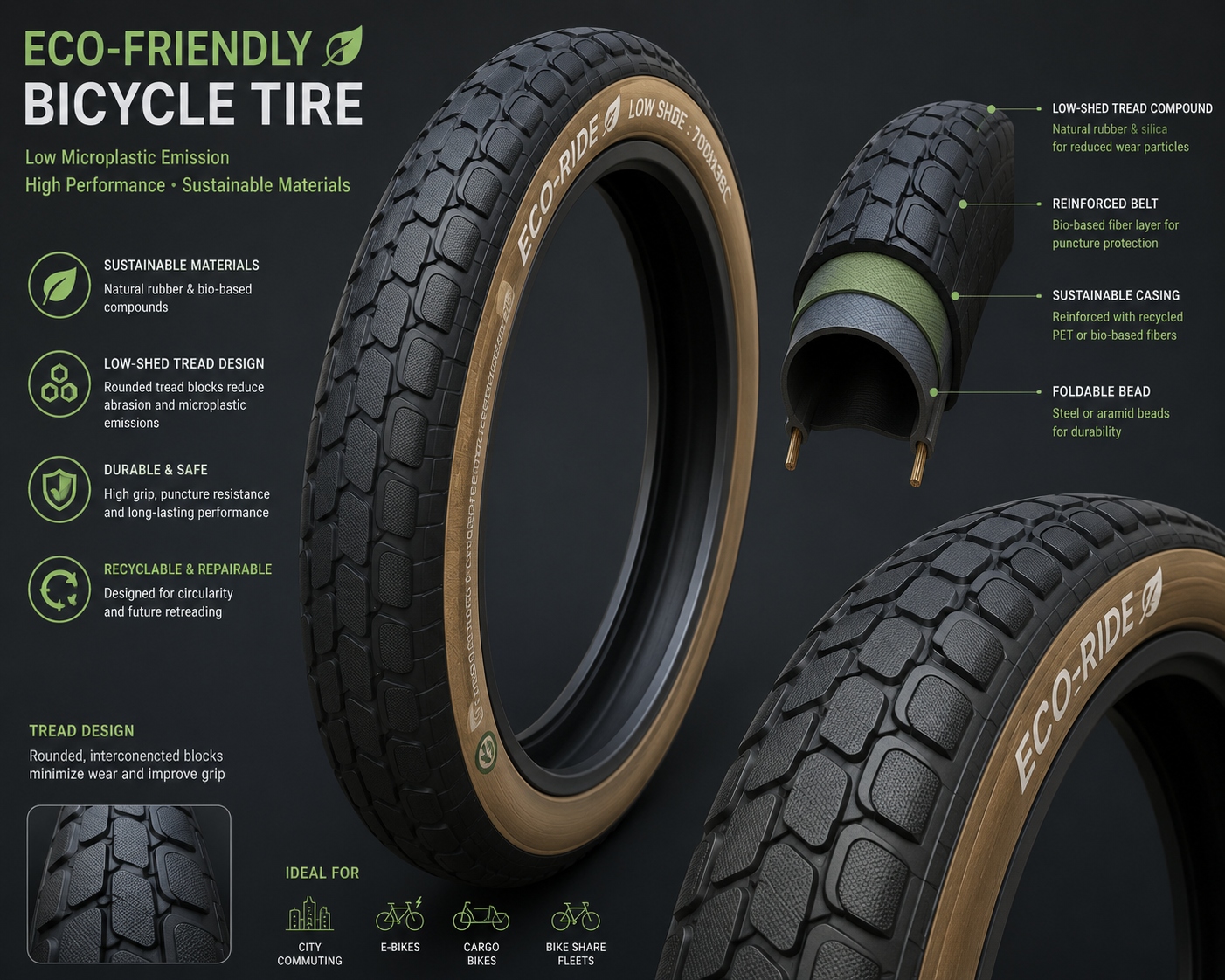
Figure 1.
commentComments
Click here for more information.
No Comments.
Cookies Notice
We use cookies to ensure that we give you the best experience on our website. By continuing to visit this site you agree to our use of cookies.
Click here for more information about the use of cookies on our website.
Click here for more information about the use of cookies on our website.