AI-Powered Garage | post-ideas.com
AI-Powered Garage
> "Will my car be ready by the next morning?"
> "You park. The garage takes care of the rest."
My Vision and Motivation:
The AI-powered garage is designed around a simple idea: your car should be ready when you need it, without requiring you to constantly think about maintenance, charging, or cleaning.
Today, vehicle ownership often involves many small, repetitive tasks: checking the battery, charging an EV, monitoring tire pressure, washing the car, checking fluid levels, noticing damage, and scheduling maintenance. These tasks are easy to postpone until they become a problem.
The AI-powered garage turns the traditional garage into an intelligent vehicle-care system. Instead of waiting for the driver to identify a problem, the garage continuously monitors the vehicle, understands its condition, predicts what it may need, and automatically takes appropriate action.
The goal is not simply to create a more futuristic garage, but to provide more convenience, better vehicle health, greater safety, and a car that is always ready to drive.
How It Works:
The system combines AI, cameras, sensors, connected vehicle data, and automated hardware.
When the car enters the garage, or even while it is parked, the system performs a virtual health check. Cameras and sensors inspect the exterior and collect information about the vehicle. Depending on the vehicle and available interfaces, the system can also access data such as battery state, charging status, tire pressure, temperature, and diagnostic information.
The AI then evaluates this information and determines whether anything requires attention.
The process can be summarized in four steps: 1. Detect → 2. Analyze → 3. Act → 4. Ready
1. Detect
AI cameras and sensors scan the vehicle for relevant changes or problems. They can detect, for example:
* Dirt, dust, mud, or water on the exterior
* Scratches, dents, or other visible damage
* Tire condition and, where supported, tire pressure
* Battery and charging status
* Unusual temperatures or warning indicators
* Fluid levels where sensors are available
* Signs that maintenance may be required
2. Analyze
The AI combines the collected information with the vehicle's history and the owner's preferences. Instead of simply reporting data, it asks: "What does this vehicle need right now, and what will it probably need soon?"
For example, if the battery is at 42% and the driver's normal departure time is the following morning, the system can determine whether charging should begin. If the vehicle is heavily soiled, it can schedule a cleaning cycle. If the system detects a potential problem that it cannot safely resolve itself, it can notify the owner.
This makes the garage proactive rather than reactive.
3. Act
When an appropriate action is identified, the garage can perform it automatically. Possible functions include:
* Automatic EV charging: The garage connects the vehicle to its charging system and charges it according to the owner's preferences, departure time, electricity prices, or available renewable energy.
* Automatic cleaning: Robotic cleaning equipment can wash, rinse, dry, or otherwise clean the vehicle.
* Tire monitoring: Sensors continuously monitor tire pressure and can alert the driver when intervention is necessary.
* Vehicle inspection: Cameras periodically inspect the exterior and compare new images with previous scans to identify changes.
* Maintenance assistance: The system can remind the owner when professional maintenance is required and potentially prepare the relevant diagnostic information for a service appointment.
* Environmental management: The garage can control lighting, ventilation, temperature, and charging to operate efficiently.
* Smart scheduling: Multiple tasks can be coordinated so that the car is charged, clean, and inspected before the next planned departure.
Importantly, the system does not have to perform every repair itself. When a task is beyond the garage's capabilities, the AI can recognize this and escalate it to the owner or a professional service provider.
4. Ready
After completing its tasks, the garage provides a simple status: "Your car is ready." The driver can see the vehicle's condition through a dashboard or smartphone application.
For example:
* 🔋 Battery: 92%
* ✓ Exterior: Clean
* ✓ Tire pressure: OK
* ✓ Vehicle diagnostics: No issues
* ✓ Ready to drive
The intention is to reduce the driver's cognitive load. Instead of managing dozens of individual maintenance tasks, the owner receives a simple overview and only needs to intervene when human attention is actually required.
Main Components:
The AI-powered garage consists of several interconnected layers.
* AI Vision & Sensor System
Cameras and sensors form the garage's perception layer. They continuously collect information about the vehicle and its surroundings.
Computer vision can identify visible dirt, damage, and changes in the vehicle's exterior, while other sensors provide information about conditions that cannot be determined visually.
*AI Control Center
The control center acts as the brain of the garage. It collects and interprets sensor data, evaluates the vehicle's condition, learns the owner's preferences, prioritizes tasks, and decides which actions should be performed automatically.
The AI could also learn from usage patterns. For example, it may recognize that the owner typically leaves at 7:30 every weekday and ensure that the vehicle is sufficiently charged and ready before then.
* Automatic Charging System
For electric vehicles, an integrated charging system can automatically charge the car when necessary. Instead of simply charging to 100% every time, the AI could consider factors such as:
* Planned departure time
* Required driving range
* Battery state
* Electricity prices
* Solar energy availability
* User preferences
* Battery-care recommendations
This can make charging more convenient and potentially more energy-efficient.
* Robotic Cleaning System
A robotic cleaning system keeps the vehicle clean without requiring the owner to visit a car wash.
Depending on the implementation, it could include water jets, brushes, air drying, vacuum systems, or more advanced contactless cleaning technologies.
The AI could determine when cleaning is necessary rather than running a full cleaning cycle every time the vehicle enters the garage.
* Monitoring & Diagnostic System
The garage continuously builds a picture of the vehicle's condition.
Rather than looking at individual measurements in isolation, AI can compare current data with historical data and identify unusual changes.
For example: Tire pressure is gradually decreasing compared with previous measurements. That information could trigger an early warning before the problem becomes critical.
* User Interface
The driver can interact with the garage through a wall-mounted display, smartphone application, or voice interface.
The interface should intentionally remain simple. The user should not have to understand all the underlying sensor data.
Instead, the system communicates meaningful information such as: "Everything is OK. Your car is charged to 92% and ready for tomorrow morning." or: "Attention: The front-left tire has lost pressure. Professional inspection recommended."
Key Benefits:
* Convenience
The biggest benefit is eliminating repetitive vehicle-care tasks. The owner does not have to remember to charge, clean, inspect, or check the vehicle every time.
* Always Ready
The garage is designed around the concept of readiness. Before a planned journey, the vehicle can be charged, clean, checked, and prepared automatically.
* Preventive Maintenance
Continuous monitoring can help identify problems earlier. Detecting a gradual change before it becomes a major failure could reduce unexpected breakdowns and potentially lower maintenance costs.
* Longer Vehicle Life
Regular cleaning, appropriate charging, and timely maintenance can contribute to maintaining the vehicle in better condition over its lifetime.
* Safety
The system can detect certain conditions that may otherwise be overlooked, such as abnormal tire pressure or visible damage. However, AI should support—not replace—professional inspection for safety-critical issues.
* Energy Efficiency
For EVs, intelligent charging can coordinate charging with electricity prices, solar generation, grid conditions, and the owner's schedule. The garage therefore becomes not only a vehicle-care system but potentially part of the home's energy-management system.
Potential Disadvantages and Challenges:
In my opinion the concept is great but also introduces several challenges.
* Cost
An intelligent garage requires cameras, sensors, charging infrastructure, robotic equipment, computing hardware, and software. The initial investment could therefore be considerably higher than that of a conventional garage.
* Complexity
More technology also means more components that can fail. The system itself requires maintenance and software updates.
* Privacy
Cameras and sensors continuously observing the vehicle and garage environment raise privacy questions. A responsible system should process as much information locally as possible and give the owner clear control over what data is stored or shared.
* AI Errors
AI-based detection is not perfect. A system might fail to recognize damage, incorrectly identify dirt, or interpret a sensor reading incorrectly. For this reason, the system should distinguish between automatic actions with low risk and decisions that require human confirmation.
* Safety
Robotic equipment operating around a vehicle and people must have strong safety mechanisms. The garage needs emergency stops, obstacle detection, access control, and fail-safe behavior. The AI should never prioritize convenience over safety.
* Compatibility
Not every vehicle provides the same diagnostic information or supports automatic functions. The garage would therefore need to support different vehicle manufacturers (not only Tesla), models, and levels of connectivity.
* The Bigger Idea
The AI-powered garage represents a shift from reactive car ownership to proactive vehicle care. Instead of the driver constantly asking:
> "What does my car need?" the garage continuously asks:
> "What can I do to make sure the car is ready?"
The garage becomes an intelligent assistant for the vehicle—monitoring its condition, taking care of routine tasks, predicting potential problems, and involving the driver only when human intervention is necessary.
Ultimately, the vision is a garage where the driver simply parks the car and walks away. The next morning, the car is clean, sufficiently charged, checked, and ready to go.
> "You park. The garage takes care of the rest."
My Vision and Motivation:
The AI-powered garage is designed around a simple idea: your car should be ready when you need it, without requiring you to constantly think about maintenance, charging, or cleaning.
Today, vehicle ownership often involves many small, repetitive tasks: checking the battery, charging an EV, monitoring tire pressure, washing the car, checking fluid levels, noticing damage, and scheduling maintenance. These tasks are easy to postpone until they become a problem.
The AI-powered garage turns the traditional garage into an intelligent vehicle-care system. Instead of waiting for the driver to identify a problem, the garage continuously monitors the vehicle, understands its condition, predicts what it may need, and automatically takes appropriate action.
The goal is not simply to create a more futuristic garage, but to provide more convenience, better vehicle health, greater safety, and a car that is always ready to drive.
How It Works:
The system combines AI, cameras, sensors, connected vehicle data, and automated hardware.
When the car enters the garage, or even while it is parked, the system performs a virtual health check. Cameras and sensors inspect the exterior and collect information about the vehicle. Depending on the vehicle and available interfaces, the system can also access data such as battery state, charging status, tire pressure, temperature, and diagnostic information.
The AI then evaluates this information and determines whether anything requires attention.
The process can be summarized in four steps: 1. Detect → 2. Analyze → 3. Act → 4. Ready
1. Detect
AI cameras and sensors scan the vehicle for relevant changes or problems. They can detect, for example:
* Dirt, dust, mud, or water on the exterior
* Scratches, dents, or other visible damage
* Tire condition and, where supported, tire pressure
* Battery and charging status
* Unusual temperatures or warning indicators
* Fluid levels where sensors are available
* Signs that maintenance may be required
2. Analyze
The AI combines the collected information with the vehicle's history and the owner's preferences. Instead of simply reporting data, it asks: "What does this vehicle need right now, and what will it probably need soon?"
For example, if the battery is at 42% and the driver's normal departure time is the following morning, the system can determine whether charging should begin. If the vehicle is heavily soiled, it can schedule a cleaning cycle. If the system detects a potential problem that it cannot safely resolve itself, it can notify the owner.
This makes the garage proactive rather than reactive.
3. Act
When an appropriate action is identified, the garage can perform it automatically. Possible functions include:
* Automatic EV charging: The garage connects the vehicle to its charging system and charges it according to the owner's preferences, departure time, electricity prices, or available renewable energy.
* Automatic cleaning: Robotic cleaning equipment can wash, rinse, dry, or otherwise clean the vehicle.
* Tire monitoring: Sensors continuously monitor tire pressure and can alert the driver when intervention is necessary.
* Vehicle inspection: Cameras periodically inspect the exterior and compare new images with previous scans to identify changes.
* Maintenance assistance: The system can remind the owner when professional maintenance is required and potentially prepare the relevant diagnostic information for a service appointment.
* Environmental management: The garage can control lighting, ventilation, temperature, and charging to operate efficiently.
* Smart scheduling: Multiple tasks can be coordinated so that the car is charged, clean, and inspected before the next planned departure.
Importantly, the system does not have to perform every repair itself. When a task is beyond the garage's capabilities, the AI can recognize this and escalate it to the owner or a professional service provider.
4. Ready
After completing its tasks, the garage provides a simple status: "Your car is ready." The driver can see the vehicle's condition through a dashboard or smartphone application.
For example:
* 🔋 Battery: 92%
* ✓ Exterior: Clean
* ✓ Tire pressure: OK
* ✓ Vehicle diagnostics: No issues
* ✓ Ready to drive
The intention is to reduce the driver's cognitive load. Instead of managing dozens of individual maintenance tasks, the owner receives a simple overview and only needs to intervene when human attention is actually required.
Main Components:
The AI-powered garage consists of several interconnected layers.
* AI Vision & Sensor System
Cameras and sensors form the garage's perception layer. They continuously collect information about the vehicle and its surroundings.
Computer vision can identify visible dirt, damage, and changes in the vehicle's exterior, while other sensors provide information about conditions that cannot be determined visually.
*AI Control Center
The control center acts as the brain of the garage. It collects and interprets sensor data, evaluates the vehicle's condition, learns the owner's preferences, prioritizes tasks, and decides which actions should be performed automatically.
The AI could also learn from usage patterns. For example, it may recognize that the owner typically leaves at 7:30 every weekday and ensure that the vehicle is sufficiently charged and ready before then.
* Automatic Charging System
For electric vehicles, an integrated charging system can automatically charge the car when necessary. Instead of simply charging to 100% every time, the AI could consider factors such as:
* Planned departure time
* Required driving range
* Battery state
* Electricity prices
* Solar energy availability
* User preferences
* Battery-care recommendations
This can make charging more convenient and potentially more energy-efficient.
* Robotic Cleaning System
A robotic cleaning system keeps the vehicle clean without requiring the owner to visit a car wash.
Depending on the implementation, it could include water jets, brushes, air drying, vacuum systems, or more advanced contactless cleaning technologies.
The AI could determine when cleaning is necessary rather than running a full cleaning cycle every time the vehicle enters the garage.
* Monitoring & Diagnostic System
The garage continuously builds a picture of the vehicle's condition.
Rather than looking at individual measurements in isolation, AI can compare current data with historical data and identify unusual changes.
For example: Tire pressure is gradually decreasing compared with previous measurements. That information could trigger an early warning before the problem becomes critical.
* User Interface
The driver can interact with the garage through a wall-mounted display, smartphone application, or voice interface.
The interface should intentionally remain simple. The user should not have to understand all the underlying sensor data.
Instead, the system communicates meaningful information such as: "Everything is OK. Your car is charged to 92% and ready for tomorrow morning." or: "Attention: The front-left tire has lost pressure. Professional inspection recommended."
Key Benefits:
* Convenience
The biggest benefit is eliminating repetitive vehicle-care tasks. The owner does not have to remember to charge, clean, inspect, or check the vehicle every time.
* Always Ready
The garage is designed around the concept of readiness. Before a planned journey, the vehicle can be charged, clean, checked, and prepared automatically.
* Preventive Maintenance
Continuous monitoring can help identify problems earlier. Detecting a gradual change before it becomes a major failure could reduce unexpected breakdowns and potentially lower maintenance costs.
* Longer Vehicle Life
Regular cleaning, appropriate charging, and timely maintenance can contribute to maintaining the vehicle in better condition over its lifetime.
* Safety
The system can detect certain conditions that may otherwise be overlooked, such as abnormal tire pressure or visible damage. However, AI should support—not replace—professional inspection for safety-critical issues.
* Energy Efficiency
For EVs, intelligent charging can coordinate charging with electricity prices, solar generation, grid conditions, and the owner's schedule. The garage therefore becomes not only a vehicle-care system but potentially part of the home's energy-management system.
Potential Disadvantages and Challenges:
In my opinion the concept is great but also introduces several challenges.
* Cost
An intelligent garage requires cameras, sensors, charging infrastructure, robotic equipment, computing hardware, and software. The initial investment could therefore be considerably higher than that of a conventional garage.
* Complexity
More technology also means more components that can fail. The system itself requires maintenance and software updates.
* Privacy
Cameras and sensors continuously observing the vehicle and garage environment raise privacy questions. A responsible system should process as much information locally as possible and give the owner clear control over what data is stored or shared.
* AI Errors
AI-based detection is not perfect. A system might fail to recognize damage, incorrectly identify dirt, or interpret a sensor reading incorrectly. For this reason, the system should distinguish between automatic actions with low risk and decisions that require human confirmation.
* Safety
Robotic equipment operating around a vehicle and people must have strong safety mechanisms. The garage needs emergency stops, obstacle detection, access control, and fail-safe behavior. The AI should never prioritize convenience over safety.
* Compatibility
Not every vehicle provides the same diagnostic information or supports automatic functions. The garage would therefore need to support different vehicle manufacturers (not only Tesla), models, and levels of connectivity.
* The Bigger Idea
The AI-powered garage represents a shift from reactive car ownership to proactive vehicle care. Instead of the driver constantly asking:
> "What does my car need?" the garage continuously asks:
> "What can I do to make sure the car is ready?"
The garage becomes an intelligent assistant for the vehicle—monitoring its condition, taking care of routine tasks, predicting potential problems, and involving the driver only when human intervention is necessary.
Ultimately, the vision is a garage where the driver simply parks the car and walks away. The next morning, the car is clean, sufficiently charged, checked, and ready to go.
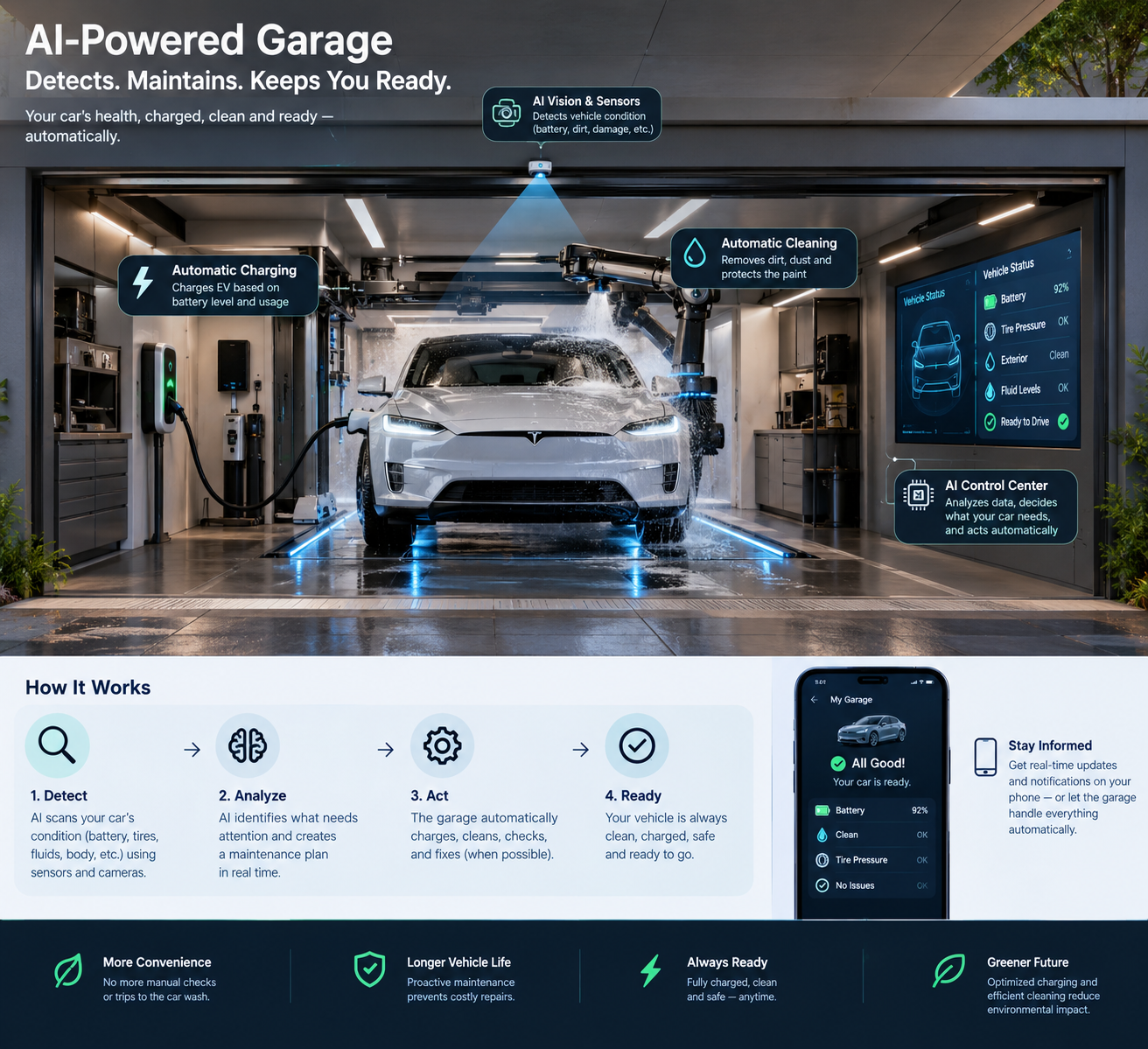
Figure 1.
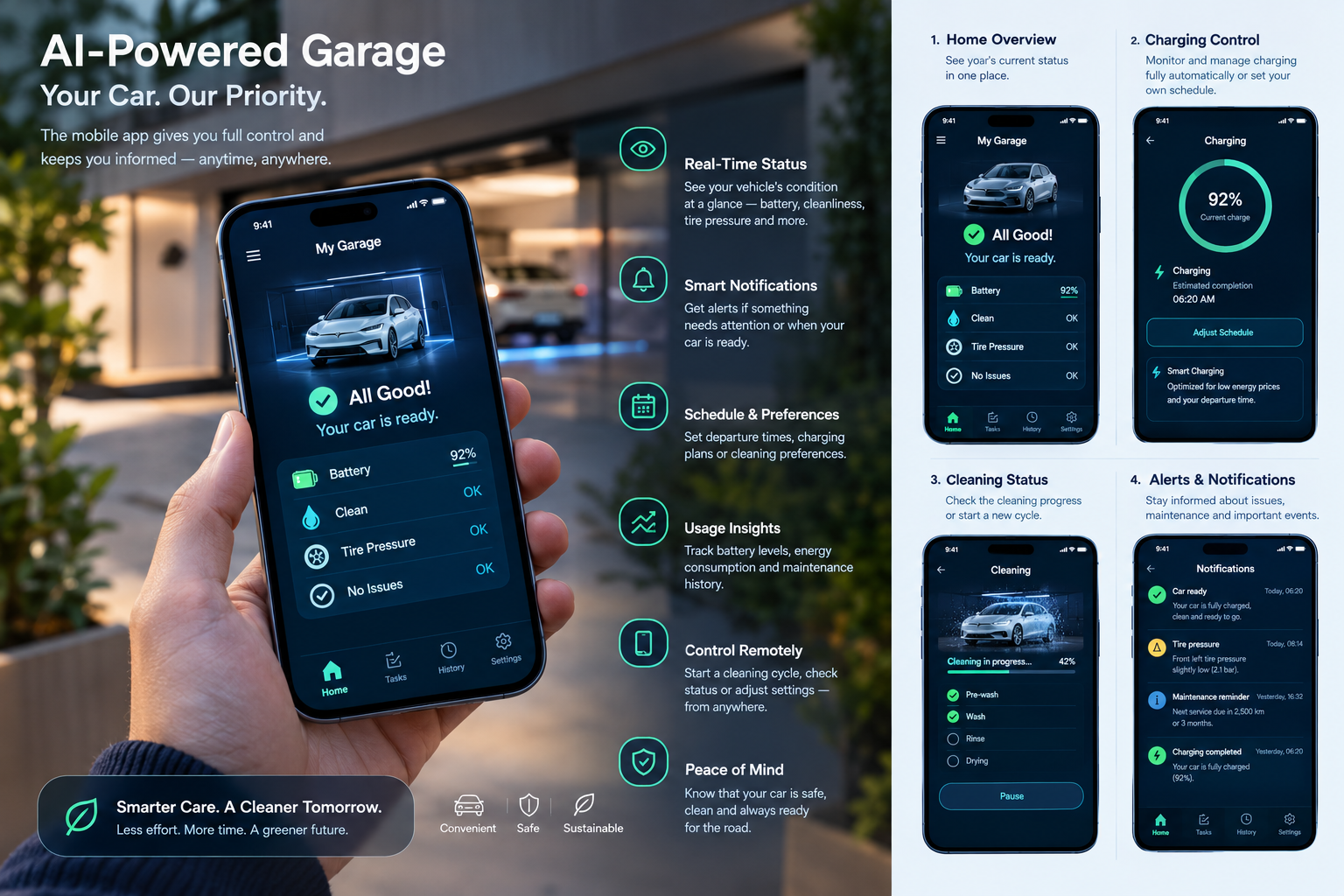
Figure 2.
commentComments
Click here for more information.
No Comments.
Cookies Notice
We use cookies to ensure that we give you the best experience on our website. By continuing to visit this site you agree to our use of cookies.
Click here for more information about the use of cookies on our website.
Click here for more information about the use of cookies on our website.