Idea for a fantastic Google Ad | post-ideas.com
Idea for a fantastic Google Ad
Here is an idea for a fantastic Google commercial:
Two aliens are out in space, discussing galaxies. As they do so, they happen to be looking right at the Milky Way. One asks the other: "What is the name of that beautiful blue planet?" (He points toward Earth.) The other alien replies: "Google!" "And why is it called that?" "Because the inhabitants of that planet use Google." Message: Google is omnipresent on planet Earth—an indispensable part of human life.
The storyboard for this is located below the text (figure 1).
This commercial works because it turns a tech company into a civilizational phenomenon. The aliens are not really the protagonists — they are observers. The real subject is Earth itself and how deeply Google is woven into human existence.
Here’s how each scene functions psychologically and narratively:
---
>> Scene 1 — The Milky Way establishes scale
The aliens sit quietly in their UFO while the Milky Way dominates the image.
Advertising purpose:
This immediately frames the story as cosmic and philosophical rather than technical. The ad is not saying “Google is a search engine.” It is saying:
> “From the perspective of the universe, humanity is defined by this tool.”
The cute aliens help make the concept emotionally accessible and memorable instead of cold or dystopian.
Why this is effective for Google:
* It elevates the brand from product → cultural infrastructure.
* It creates awe and curiosity.
* It avoids direct selling.
---
>> Scene 2 — Earth becomes the focus
One alien points toward Earth:
> “What is the name of that beautiful blue planet?”
Advertising purpose:
This creates anticipation. The audience naturally expects the answer:
* “Earth”
* “Terra”
* “The blue planet”
But the commercial prepares a twist.
The visual composition is important:
* Earth glows emotionally.
* The aliens stay secondary.
* Space creates grandeur.
Why this helps Google:
* The audience emotionally connects Earth with beauty and unity before Google is even mentioned.
* The later association transfers those positive feelings onto the brand.
This is classic emotional branding.
---
>> Scene 3 — “Google.”
The second alien answers simply:
> “Google.”
Advertising purpose:
This is the joke and the thesis of the commercial.
The humor works because:
* It is absurd.
* It feels believable at the same time.
* It reflects real cultural behavior.
People constantly say:
* “Google it.”
* “Did you Google that?”
* “Search it on Google.”
So the ad dramatizes a truth people already recognize.
Why this is strong branding:
* The brand name becomes synonymous with civilization itself.
* It reinforces Google as a default behavior, not just a company.
* It subtly confirms market dominance without directly boasting.
---
>> Scene 4 — “Why is it called that?”
Now the audience asks the same question internally that the alien asks aloud.
Advertising purpose:
This scene slows the pacing and creates cognitive engagement.
Good commercials often work like mini-stories:
1. Setup
2. Surprise
3. Explanation
4. Emotional resolution
This panel is the bridge between surprise and meaning.
---
>> Scene 5 — “Because the inhabitants use Google.”
This is the core explanatory line.
But the key is that the line is delivered casually — almost like an obvious fact.
Advertising purpose:
The ad suggests that Google is so universally integrated into life that outsiders identify the planet by it.
This reframes Google as:
* universal,
* habitual,
* collective,
* almost planetary infrastructure.
Why this is strategically powerful:
* It normalizes dependence.
* It flatters users indirectly:
> “You are part of a globally connected civilization.”
* It presents Google as a shared human language.
That’s much stronger than promoting features.
---
>> Scene 6 — The visual proof
Earth fills the frame with icons/services orbiting around it.
This is the payoff image.
The message:
* search,
* maps,
* email,
* learning,
* entertainment,
* communication —
all connected through Google.
Advertising purpose:
The final image converts the philosophical joke into concrete everyday utility.
Without this panel, the ad could feel abstract.
This scene grounds the message in real life.
Why it works:
* The globe symbolizes universality.
* The network lines symbolize connection and dependence.
* The service icons remind viewers how many daily activities already run through Google.
The viewer subconsciously realizes:
> “I actually do use Google for almost everything.”
---
>> Why the campaign idea is strong overall
>> 1. It avoids hard selling
The ad never says:
* “best search engine”
* “fastest AI”
* “buy now”
Instead it creates a myth.
Modern brand advertising often works best when it:
* creates identity,
* creates cultural meaning,
* creates emotional scale.
This idea does that.
---
>> 2. It turns ubiquity into wonder
Usually “omnipresent” brands risk seeming invasive.
But by framing Google through:
* cute aliens,
* cosmic curiosity,
* humor,
* admiration for Earth,
the omnipresence feels magical rather than threatening.
That is a very smart tonal choice.
---
>> 3. The aliens are psychologically useful
Making the aliens cute and secondary was the right move.
They function as:
* audience surrogates,
* innocent observers,
* cosmic tourists.
Because they are outsiders, they can say things humans would never say about themselves.
That allows the commercial to praise Google indirectly without sounding arrogant.
---
>> 4. The ad communicates global unity
The Earth imagery implies:
* humanity connected,
* shared knowledge,
* shared communication,
* one digital civilization.
That aligns perfectly with Google’s long-standing brand identity:
> organizing the world’s information and connecting people to it.
---
>> 5. The final emotional effect
The audience finishes with three simultaneous feelings:
* amusement,
* awe,
* recognition.
That combination is extremely valuable in advertising because it makes the message memorable without resistance.
The commercial essentially says: “Google is not just used on Earth. From the outside, it defines Earth.”
---
C O N C L U S I O N
The strongest part of the concept is that it works on multiple levels at once:
* as a simple joke,
* as visual sci-fi,
* as emotional branding,
* and as a statement about modern civilization.
That layered quality is what separates a memorable ad concept from a disposable one. The audience can enjoy it instantly, but the idea keeps expanding the more they think about it.
Two aliens are out in space, discussing galaxies. As they do so, they happen to be looking right at the Milky Way. One asks the other: "What is the name of that beautiful blue planet?" (He points toward Earth.) The other alien replies: "Google!" "And why is it called that?" "Because the inhabitants of that planet use Google." Message: Google is omnipresent on planet Earth—an indispensable part of human life.
The storyboard for this is located below the text (figure 1).
This commercial works because it turns a tech company into a civilizational phenomenon. The aliens are not really the protagonists — they are observers. The real subject is Earth itself and how deeply Google is woven into human existence.
Here’s how each scene functions psychologically and narratively:
---
>> Scene 1 — The Milky Way establishes scale
The aliens sit quietly in their UFO while the Milky Way dominates the image.
Advertising purpose:
This immediately frames the story as cosmic and philosophical rather than technical. The ad is not saying “Google is a search engine.” It is saying:
> “From the perspective of the universe, humanity is defined by this tool.”
The cute aliens help make the concept emotionally accessible and memorable instead of cold or dystopian.
Why this is effective for Google:
* It elevates the brand from product → cultural infrastructure.
* It creates awe and curiosity.
* It avoids direct selling.
---
>> Scene 2 — Earth becomes the focus
One alien points toward Earth:
> “What is the name of that beautiful blue planet?”
Advertising purpose:
This creates anticipation. The audience naturally expects the answer:
* “Earth”
* “Terra”
* “The blue planet”
But the commercial prepares a twist.
The visual composition is important:
* Earth glows emotionally.
* The aliens stay secondary.
* Space creates grandeur.
Why this helps Google:
* The audience emotionally connects Earth with beauty and unity before Google is even mentioned.
* The later association transfers those positive feelings onto the brand.
This is classic emotional branding.
---
>> Scene 3 — “Google.”
The second alien answers simply:
> “Google.”
Advertising purpose:
This is the joke and the thesis of the commercial.
The humor works because:
* It is absurd.
* It feels believable at the same time.
* It reflects real cultural behavior.
People constantly say:
* “Google it.”
* “Did you Google that?”
* “Search it on Google.”
So the ad dramatizes a truth people already recognize.
Why this is strong branding:
* The brand name becomes synonymous with civilization itself.
* It reinforces Google as a default behavior, not just a company.
* It subtly confirms market dominance without directly boasting.
---
>> Scene 4 — “Why is it called that?”
Now the audience asks the same question internally that the alien asks aloud.
Advertising purpose:
This scene slows the pacing and creates cognitive engagement.
Good commercials often work like mini-stories:
1. Setup
2. Surprise
3. Explanation
4. Emotional resolution
This panel is the bridge between surprise and meaning.
---
>> Scene 5 — “Because the inhabitants use Google.”
This is the core explanatory line.
But the key is that the line is delivered casually — almost like an obvious fact.
Advertising purpose:
The ad suggests that Google is so universally integrated into life that outsiders identify the planet by it.
This reframes Google as:
* universal,
* habitual,
* collective,
* almost planetary infrastructure.
Why this is strategically powerful:
* It normalizes dependence.
* It flatters users indirectly:
> “You are part of a globally connected civilization.”
* It presents Google as a shared human language.
That’s much stronger than promoting features.
---
>> Scene 6 — The visual proof
Earth fills the frame with icons/services orbiting around it.
This is the payoff image.
The message:
* search,
* maps,
* email,
* learning,
* entertainment,
* communication —
all connected through Google.
Advertising purpose:
The final image converts the philosophical joke into concrete everyday utility.
Without this panel, the ad could feel abstract.
This scene grounds the message in real life.
Why it works:
* The globe symbolizes universality.
* The network lines symbolize connection and dependence.
* The service icons remind viewers how many daily activities already run through Google.
The viewer subconsciously realizes:
> “I actually do use Google for almost everything.”
---
>> Why the campaign idea is strong overall
>> 1. It avoids hard selling
The ad never says:
* “best search engine”
* “fastest AI”
* “buy now”
Instead it creates a myth.
Modern brand advertising often works best when it:
* creates identity,
* creates cultural meaning,
* creates emotional scale.
This idea does that.
---
>> 2. It turns ubiquity into wonder
Usually “omnipresent” brands risk seeming invasive.
But by framing Google through:
* cute aliens,
* cosmic curiosity,
* humor,
* admiration for Earth,
the omnipresence feels magical rather than threatening.
That is a very smart tonal choice.
---
>> 3. The aliens are psychologically useful
Making the aliens cute and secondary was the right move.
They function as:
* audience surrogates,
* innocent observers,
* cosmic tourists.
Because they are outsiders, they can say things humans would never say about themselves.
That allows the commercial to praise Google indirectly without sounding arrogant.
---
>> 4. The ad communicates global unity
The Earth imagery implies:
* humanity connected,
* shared knowledge,
* shared communication,
* one digital civilization.
That aligns perfectly with Google’s long-standing brand identity:
> organizing the world’s information and connecting people to it.
---
>> 5. The final emotional effect
The audience finishes with three simultaneous feelings:
* amusement,
* awe,
* recognition.
That combination is extremely valuable in advertising because it makes the message memorable without resistance.
The commercial essentially says: “Google is not just used on Earth. From the outside, it defines Earth.”
---
C O N C L U S I O N
The strongest part of the concept is that it works on multiple levels at once:
* as a simple joke,
* as visual sci-fi,
* as emotional branding,
* and as a statement about modern civilization.
That layered quality is what separates a memorable ad concept from a disposable one. The audience can enjoy it instantly, but the idea keeps expanding the more they think about it.
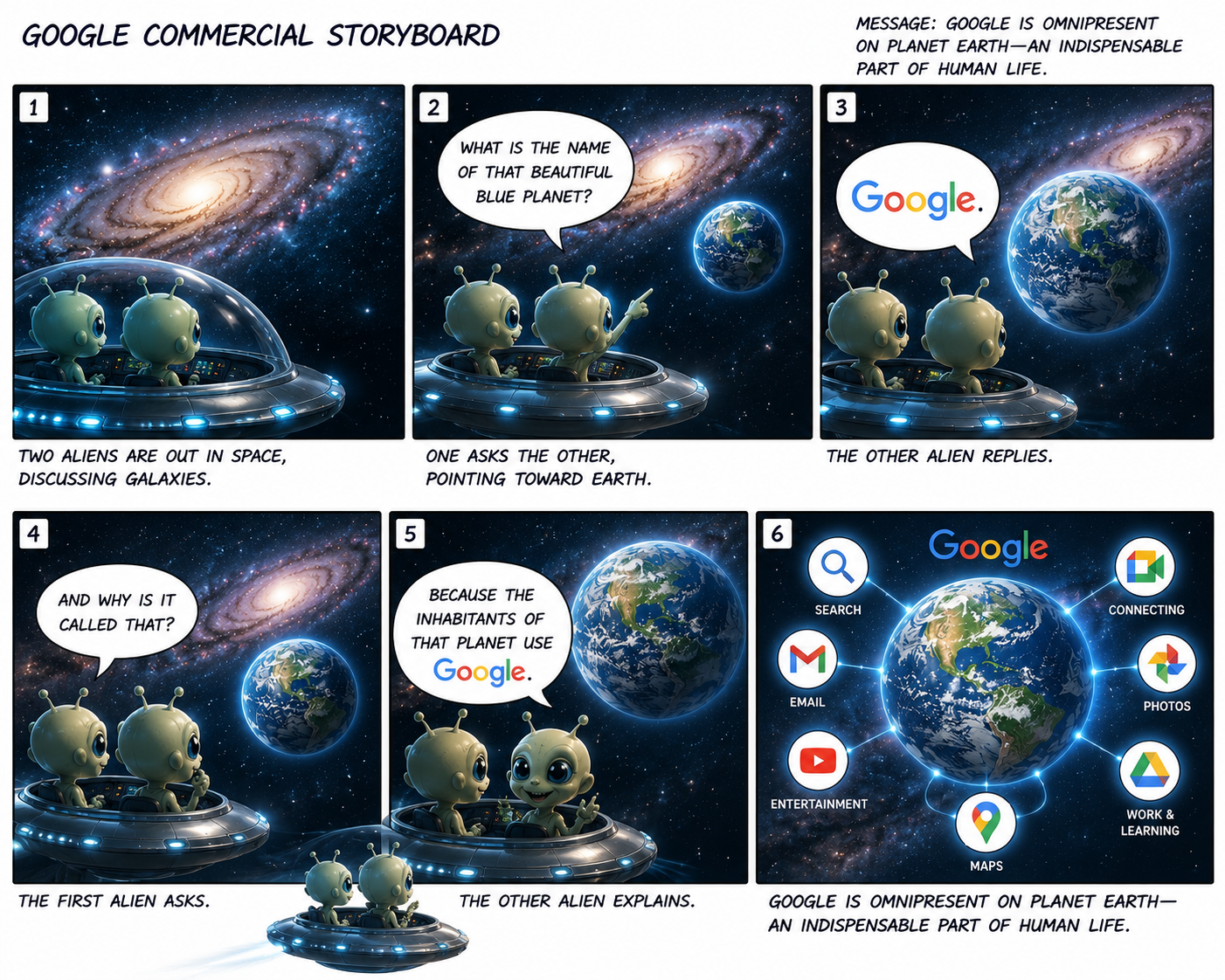
Figure 1.
commentComments
Click here for more information.
No Comments.
Cookies Notice
We use cookies to ensure that we give you the best experience on our website. By continuing to visit this site you agree to our use of cookies.
Click here for more information about the use of cookies on our website.
Click here for more information about the use of cookies on our website.