AI Doctor Pod | post-ideas.com
AI Doctor Pod
AI Doctor Pod: Autonomous Home Medical Diagnosis and Treatment System
Here are my thoughts on tomorrow's health care:
Executive Summary
The AI Doctor Pod is a futuristic home-based medical system designed to provide comprehensive health assessment, diagnosis, monitoring, and selected medical interventions within a self-contained capsule-like unit. A user lies inside the pod, where advanced sensors, imaging systems, artificial intelligence, and robotic technologies work together to create a highly detailed understanding of the user's health status.
The long-term vision is to make expert-level healthcare accessible 24/7 from home, reducing barriers to medical care, enabling earlier disease detection, and supporting healthcare professionals with advanced diagnostic and treatment capabilities.
My Vision
Imagine a device as common as a home appliance that can perform a complete medical examination in minutes. The AI Doctor Pod would continuously monitor health, identify diseases before symptoms become severe, provide treatment recommendations, and connect patients with human physicians when necessary.
Rather than replacing doctors, the system would function as an intelligent healthcare platform that augments medical expertise and expands access to care.
Here are the details of the concept: Core System Architecture
1. Patient Capsule
The pod is a comfortable, enclosed chamber designed for safety and relaxation. It includes: ergonomic patient bed, environmental control (temperature, humidity, air quality), emergency communication system, transparent display panels, sterile treatment environment and biometric monitoring systems.
2. Full-Body Scanning Suite
The pod combines multiple scanning technologies:
* External Imaging including high-resolution optical cameras, 3D body mapping, dermatological skin analysis, motion and posture assessment and facial diagnostic analysis.
* Internal Imaging. Potential future technologies may include: portable MRI-like systems, ultrasound arrays, advanced low-radiation imaging, optical tomography and molecular imaging sensors.
* Vital Monitoring. Continuous measurement of: heart rate, blood pressure, blood oxygen, respiratory function, body temperature, neurological activity, sleep quality and metabolic indicators.
3. AI Diagnostic Engine
At the center of the system is a medical AI platform.
The capabilities include symptom interpretation, medical image analysis, disease prediction, risk assessment, personalized health recommendations, drug interaction checking and longitudinal health tracking.
The knowledge sources are medical literature, clinical guidelines, hospital treatment protocols, patient history and population health databases.
The AI continuously updates its understanding as new medical research becomes available.
4. Automated Laboratory Module
The pod could collect and analyze biological samples. The sample collection including blood micro-sampling, saliva testing, urine analysis and breath analysis.
The laboratory functions could comprise infection detection, hormone analysis, blood chemistry, genetic screening and cancer biomarker testing.
Results are integrated directly into the AI diagnostic model.
5. Robotic Treatment System
The treatment module uses precision robotic arms.
Low-risk procedures could include the following potential future applications: wound cleaning, bandaging, injection delivery, vaccinations, IV placement and physical therapy assistance.
There could also exist advanced procedures by using the AI Doctor Pod. But for higher-risk interventions, human medical supervision would likely remain essential. So the system could support remote-controlled robotic surgery, physician-guided procedures and emergency stabilization.
Safety systems would require multiple layers of verification before any intervention occurs.
6. Digital Health Twin
The AI creates a continuously updated digital model of the patient's body. The health twin contains organ health status, medical history, genetic information, lifestyle patterns, disease risk forecasts and treatment responses. This allows personalized medicine tailored to each individual.
User Experience - Steps of the daily health scan:
1. User enters pod.
2. Identity is verified.
3. Full-body scan begins.
4. AI analyzes results.
5. Health report is generated.
6. Recommendations are provided.
Time required: approximately 5–15 minutes.
When symptoms occur - Diagnostic session:
1. User describes symptoms.
2. AI performs targeted scanning.
3. Laboratory samples are collected if needed.
4. Diagnosis probabilities are generated.
5. Treatment plan is proposed.
6. Human physician consultation is initiated when necessary.
Safety Framework
Because medical diagnosis and treatment directly affect human life, safety is the highest priority. So there are several safety layers: human physician oversight, multiple AI verification systems, real-time monitoring, emergency shutdown capability, regulatory compliance, continuous auditing and cybersecurity protection.
Ethical Requirements would consider the patient privacy, informed consent, explainable AI decisions, transparent medical reasoning and human override authority.
Potential benefits for patients:
Immediate healthcare access, earlier disease detection, reduced healthcare costs, personalized treatment and continuous monitoring.
Potential benefits for healthcare systems:
Reduced hospital burden, faster triage, better preventive care, improved data-driven medicine and expanded rural healthcare access.
Technical Challenges - Several breakthroughs would be required
* Hardware Challenges (compact imaging systems, home-safe medical robotics, sterile autonomous environments, reliable biological testing)
* AI Challenges (near-clinical diagnostic accuracy, medical reasoning transparency, rare disease recognition, bias reduction)
* Regulatory Challenges (medical certification, liability frameworks, safety validation, international compliance)
The Development Roadmap
* Phase 1 (Present-Day Technology): Health monitoring pod, AI health assistant, vital sign analysis, telemedicine integration
* Phase 2: Automated diagnostics, laboratory testing, advanced imaging, digital health twin
* Phase 3: Semi-autonomous treatment systems, remote physician-guided robotics, predictive disease prevention
* Phase 4 (Long-Term Vision): Fully integrated AI Doctor Pod, comprehensive autonomous diagnostics, continuous health optimization, global healthcare network connectivity
Conclusion
The AI Doctor Pod represents a vision of future healthcare where advanced artificial intelligence, medical imaging, robotics, and personalized medicine converge into a single home-based platform. While fully autonomous diagnosis and surgery remain significant scientific, engineering, safety, and regulatory challenges, the concept provides a roadmap toward highly accessible, preventive, and personalized healthcare for the future.
Here are my thoughts on tomorrow's health care:
Executive Summary
The AI Doctor Pod is a futuristic home-based medical system designed to provide comprehensive health assessment, diagnosis, monitoring, and selected medical interventions within a self-contained capsule-like unit. A user lies inside the pod, where advanced sensors, imaging systems, artificial intelligence, and robotic technologies work together to create a highly detailed understanding of the user's health status.
The long-term vision is to make expert-level healthcare accessible 24/7 from home, reducing barriers to medical care, enabling earlier disease detection, and supporting healthcare professionals with advanced diagnostic and treatment capabilities.
My Vision
Imagine a device as common as a home appliance that can perform a complete medical examination in minutes. The AI Doctor Pod would continuously monitor health, identify diseases before symptoms become severe, provide treatment recommendations, and connect patients with human physicians when necessary.
Rather than replacing doctors, the system would function as an intelligent healthcare platform that augments medical expertise and expands access to care.
Here are the details of the concept: Core System Architecture
1. Patient Capsule
The pod is a comfortable, enclosed chamber designed for safety and relaxation. It includes: ergonomic patient bed, environmental control (temperature, humidity, air quality), emergency communication system, transparent display panels, sterile treatment environment and biometric monitoring systems.
2. Full-Body Scanning Suite
The pod combines multiple scanning technologies:
* External Imaging including high-resolution optical cameras, 3D body mapping, dermatological skin analysis, motion and posture assessment and facial diagnostic analysis.
* Internal Imaging. Potential future technologies may include: portable MRI-like systems, ultrasound arrays, advanced low-radiation imaging, optical tomography and molecular imaging sensors.
* Vital Monitoring. Continuous measurement of: heart rate, blood pressure, blood oxygen, respiratory function, body temperature, neurological activity, sleep quality and metabolic indicators.
3. AI Diagnostic Engine
At the center of the system is a medical AI platform.
The capabilities include symptom interpretation, medical image analysis, disease prediction, risk assessment, personalized health recommendations, drug interaction checking and longitudinal health tracking.
The knowledge sources are medical literature, clinical guidelines, hospital treatment protocols, patient history and population health databases.
The AI continuously updates its understanding as new medical research becomes available.
4. Automated Laboratory Module
The pod could collect and analyze biological samples. The sample collection including blood micro-sampling, saliva testing, urine analysis and breath analysis.
The laboratory functions could comprise infection detection, hormone analysis, blood chemistry, genetic screening and cancer biomarker testing.
Results are integrated directly into the AI diagnostic model.
5. Robotic Treatment System
The treatment module uses precision robotic arms.
Low-risk procedures could include the following potential future applications: wound cleaning, bandaging, injection delivery, vaccinations, IV placement and physical therapy assistance.
There could also exist advanced procedures by using the AI Doctor Pod. But for higher-risk interventions, human medical supervision would likely remain essential. So the system could support remote-controlled robotic surgery, physician-guided procedures and emergency stabilization.
Safety systems would require multiple layers of verification before any intervention occurs.
6. Digital Health Twin
The AI creates a continuously updated digital model of the patient's body. The health twin contains organ health status, medical history, genetic information, lifestyle patterns, disease risk forecasts and treatment responses. This allows personalized medicine tailored to each individual.
User Experience - Steps of the daily health scan:
1. User enters pod.
2. Identity is verified.
3. Full-body scan begins.
4. AI analyzes results.
5. Health report is generated.
6. Recommendations are provided.
Time required: approximately 5–15 minutes.
When symptoms occur - Diagnostic session:
1. User describes symptoms.
2. AI performs targeted scanning.
3. Laboratory samples are collected if needed.
4. Diagnosis probabilities are generated.
5. Treatment plan is proposed.
6. Human physician consultation is initiated when necessary.
Safety Framework
Because medical diagnosis and treatment directly affect human life, safety is the highest priority. So there are several safety layers: human physician oversight, multiple AI verification systems, real-time monitoring, emergency shutdown capability, regulatory compliance, continuous auditing and cybersecurity protection.
Ethical Requirements would consider the patient privacy, informed consent, explainable AI decisions, transparent medical reasoning and human override authority.
Potential benefits for patients:
Immediate healthcare access, earlier disease detection, reduced healthcare costs, personalized treatment and continuous monitoring.
Potential benefits for healthcare systems:
Reduced hospital burden, faster triage, better preventive care, improved data-driven medicine and expanded rural healthcare access.
Technical Challenges - Several breakthroughs would be required
* Hardware Challenges (compact imaging systems, home-safe medical robotics, sterile autonomous environments, reliable biological testing)
* AI Challenges (near-clinical diagnostic accuracy, medical reasoning transparency, rare disease recognition, bias reduction)
* Regulatory Challenges (medical certification, liability frameworks, safety validation, international compliance)
The Development Roadmap
* Phase 1 (Present-Day Technology): Health monitoring pod, AI health assistant, vital sign analysis, telemedicine integration
* Phase 2: Automated diagnostics, laboratory testing, advanced imaging, digital health twin
* Phase 3: Semi-autonomous treatment systems, remote physician-guided robotics, predictive disease prevention
* Phase 4 (Long-Term Vision): Fully integrated AI Doctor Pod, comprehensive autonomous diagnostics, continuous health optimization, global healthcare network connectivity
Conclusion
The AI Doctor Pod represents a vision of future healthcare where advanced artificial intelligence, medical imaging, robotics, and personalized medicine converge into a single home-based platform. While fully autonomous diagnosis and surgery remain significant scientific, engineering, safety, and regulatory challenges, the concept provides a roadmap toward highly accessible, preventive, and personalized healthcare for the future.
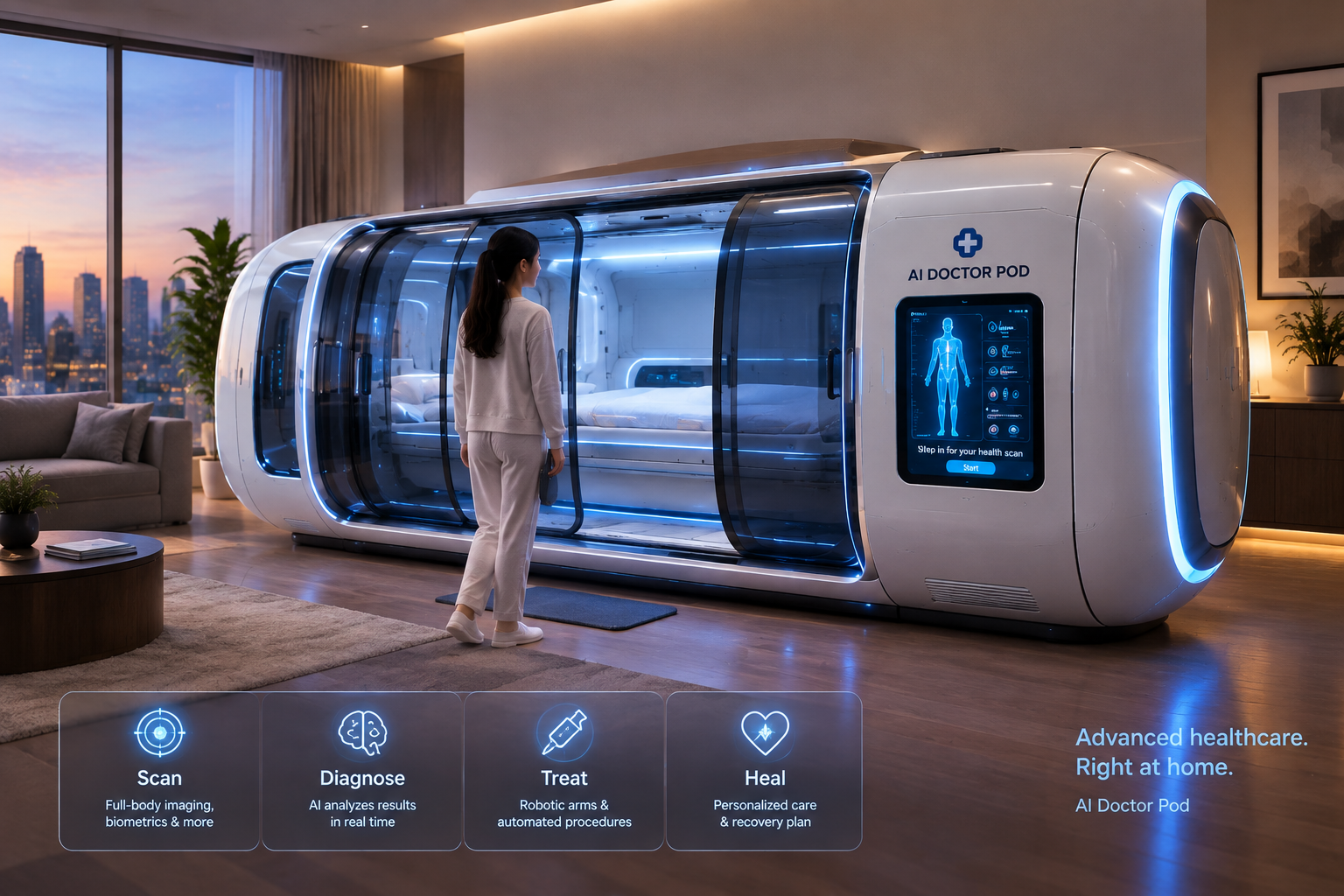
Figure 1.
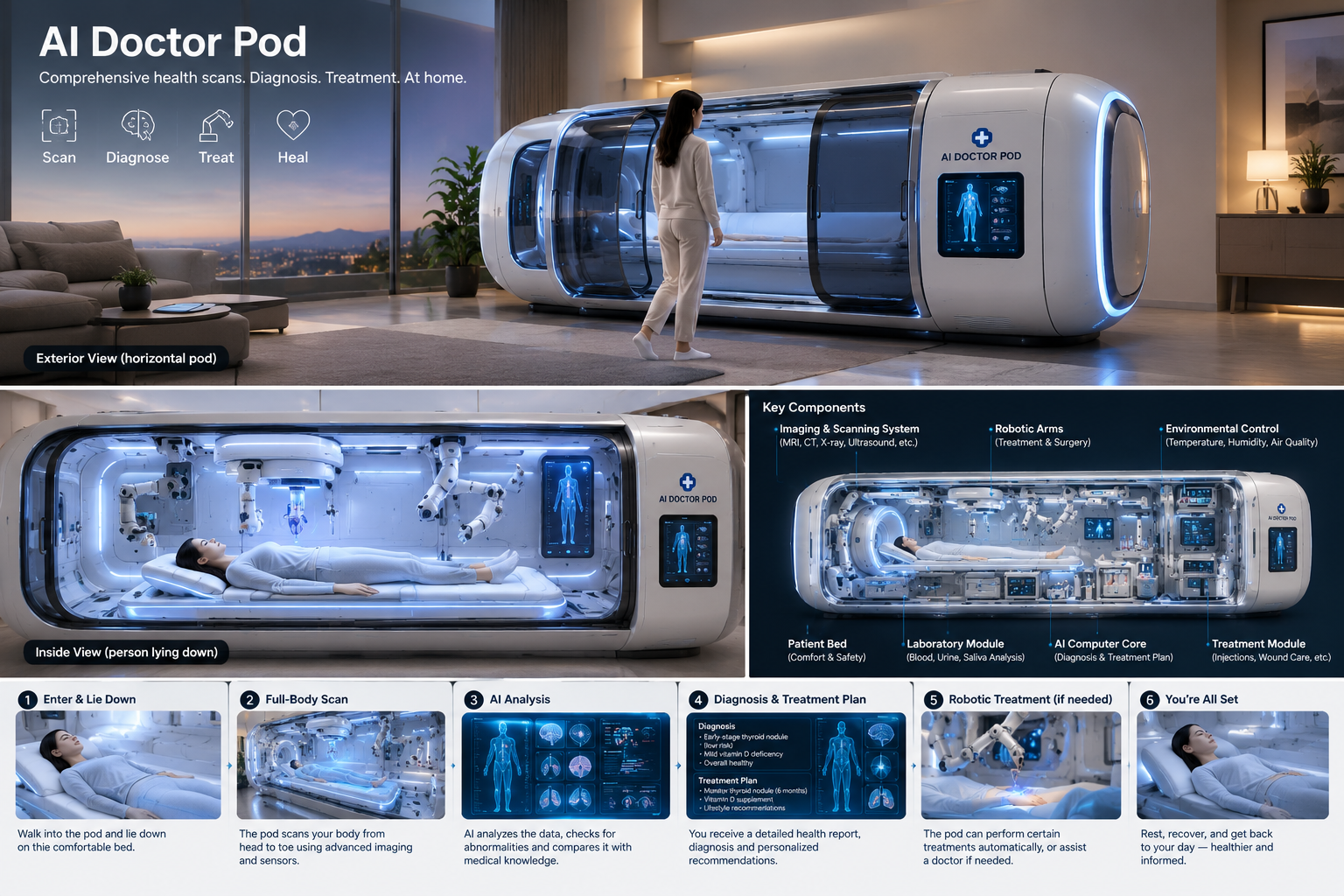
Figure 2.
commentComments
Click here for more information.
No Comments.
Cookies Notice
We use cookies to ensure that we give you the best experience on our website. By continuing to visit this site you agree to our use of cookies.
Click here for more information about the use of cookies on our website.
Click here for more information about the use of cookies on our website.