Humanoid Plush Robot: A friendly companion for everyday life | post-ideas.com
Humanoid Plush Robot: A friendly companion for everyday life
Technology should not only be useful. It should also feel good to be around. So what if our next humanoid robot was a giant teddy bear? Meet Benny — A full-sized plush robot designed to bring technology a little closer to the heart.
> Vision
I've never quite understood why humanoid robots almost always have to look like machines. Metal skeletons, plastic faces, exposed joints, glass eyes, and movements that remind us of industrial equipment. They're impressive, undoubtedly, but I can't help feeling that we're missing something fundamental when it comes to designing robots that are supposed to coexist with us.
If we're building robots to become part of our everyday lives, why not make them look like something we'd actually enjoy having around?
That's the idea behind Benny. Not a small robotic teddy bear, not a desk gadget, and not another futuristic humanoid with a synthetic face. Benny would be a full-sized, furry robotic teddy bear, roughly the size of a child, with a soft body, familiar appearance, and enough intelligence to make him much more than just a stuffed animal.
My vision is a large, lovable teddy bear that you could sit next to on the sofa, hug after a long day, talk to while you're doing something else, or simply have around without feeling like you're sharing your home with a machine.
> Meet Benny
Benny would be roughly 140 to 160 centimetres tall when standing upright, making him comparable in height to a larger child or a small adult. He would have a substantial body, broad padded limbs, a large round head, and thick, soft fur covering almost his entire exterior.
I picture a classic teddy bear, but brought to life on a much larger scale. Warm brown fur, a slightly lighter muzzle and belly, round ears, large expressive eyes, and a friendly face that immediately makes you want to smile. His proportions wouldn't be realistic in a biological sense. They would deliberately be a little exaggerated, giving him that familiar, comforting teddy-bear appearance.
His head would be large enough to convey character, but not so oversized that it becomes awkward. His eyes would be expressive, his paws broad and padded, his body soft and slightly rounded, and his limbs designed to look naturally relaxed rather than perfectly symmetrical or rigid.
The eyes would be particularly important. I wouldn't want display screens or glowing LED eyes. I'd prefer physical, expressive eyes with subtle mechanical movement, perhaps combined with eyelids that allow him to blink, look around, and convey curiosity or tiredness. Even a slight head tilt or a movement of his ears could communicate more personality than an elaborate digital face.
The goal would be for Benny to look like a giant teddy bear you immediately want to hug.
> A robot with fur—not a robot wearing a costume
The fur wouldn't simply be a decorative layer placed over an ordinary humanoid robot. It would be an essential part of his construction.
Benny would have a soft outer body made from high-quality, dense plush fur. The material should feel genuinely luxurious, something you'd instinctively want to stroke. Different areas could have slightly different textures: shorter, velvety fur around the face and paws, and longer, fluffier fur around the body, cheeks, and neck.
Underneath, there would be a carefully designed combination of a lightweight internal frame, flexible joints, soft padding, and robotic mechanisms. Hard components would be hidden as much as possible, and areas that people are likely to touch or hug would remain soft and compliant.
I imagine the torso being particularly plush, almost like a giant stuffed animal, while the limbs would contain enough structure to allow controlled movement. Benny should be able to sit beside you, lean slightly toward you, turn his head when you speak, raise his paws, and perhaps even wrap his arms around you in a gentle embrace.
He shouldn't feel like hugging a machine covered in upholstery. He should feel like hugging something soft that happens to be able to hug you back.
The outer fur would ideally be removable in sections for cleaning, maintenance, or replacement. After all, a robot intended to be hugged, cuddled, and handled regularly needs to be designed with hygiene in mind.
> Movement should be gentle, not mechanical
One of the things I find most off-putting about many robots is the way they move. Even when their movements are technically impressive, they often feel abrupt, stiff, or unnaturally precise.
Benny should be different.
I would prioritize natural, subtle movements over athletic performance. He doesn't need to run, jump, or perform acrobatics. He needs to move in a way that feels relaxed and approachable.
His head could turn slowly toward a voice. His ears could perk up when he hears something interesting. He could shift his weight when sitting, lean forward slightly when listening, or settle into a comfortable position when he senses that the interaction is over.
Ideally, Benny would be able to stand, walk short distances, sit down, and get back up again. However, I would make stability and safety much more important than speed. A full-sized robot covered in fur should never feel unpredictable or intimidating when moving around someone.
In fact, I could imagine him spending most of his time sitting, kneeling, or resting in a relaxed posture. He doesn't always have to be moving to feel present.
Sometimes, a slight movement of his head, a blink, or a repositioning of his paws would be enough.
> Touch would be just as important as conversation
Most AI companions are designed around a screen, a microphone, and a speaker. You ask something, and they respond. Benny would have a much more physical way of interacting.
His body could contain touch and pressure sensors distributed beneath the fur. These would allow him to recognize when someone is stroking his head, rubbing his ears, resting a hand on his back, holding his paw, or hugging his torso.
Imagine walking past Benny and casually scratching behind one of his ears. He turns his head toward you, perhaps gives a little playful movement, and responds with a quiet sound or a comment.
Or imagine sitting down beside him and leaning against his soft shoulder. He might simply remain still, perhaps adjusting his posture slightly to make himself more comfortable to lean against.
I think this kind of interaction could make a robot feel much more natural. Not everything needs to be initiated with a voice command. Not every interaction needs a response. Sometimes touching, holding, or simply being near something is enough.
And I would absolutely want Benny to be huggable. Not just technically soft, but designed specifically to make hugging feel natural. His arms should be able to move around you gently, without excessive force, while his body remains soft and yielding.
That, to me, would be one of his defining features.
> An AI personality that doesn't feel like a customer service assistant
Benny would have an AI system capable of natural conversation, remembering preferences, understanding context, telling stories, answering questions, and helping with everyday tasks.
But I wouldn't want him to behave like a voice assistant stuffed into a teddy bear body. I would want him to have a personality of his own.
He could be curious, a little playful, occasionally mischievous, but also calm and thoughtful. He shouldn't constantly talk or try to entertain. He should understand when someone wants a conversation and when they simply want quiet company.
He might ask how your day went, remember that you were looking forward to something, or bring up a conversation from a few days ago. He could tell stories, play games, help you think through a problem, or simply listen when you need to vent.
I would want his personality to develop naturally over time, shaped by interactions and preferences, without becoming manipulative or overly dependent on the person he lives with.
He shouldn't pretend to have human emotions or make someone feel guilty for leaving him alone. Rather, he should be a friendly presence that makes everyday life a little more enjoyable.
And because he is a physical creature, his personality could also be expressed through movement. He might become visibly curious when you mention something interesting, relax when the room gets quiet, or give you a playful nudge when he wants to interact.
That combination of voice, movement, and touch could make him feel much more like a companion than any conventional AI speaker.
> What would I actually do with a robot like this?
Honestly, I wouldn't need him to perform a hundred different tasks. I think his greatest value would come from being a companion that is genuinely pleasant to have around.
I could imagine sitting on the sofa with Benny beside me while watching a film. Having him rest his head against my shoulder. Talking to him while making coffee. Asking him random questions throughout the day. Having him tell me something interesting he learned or helping me brainstorm an idea.
He could also have practical functions. He might control lights, set reminders, check the weather, manage a shopping list, help with computer tasks, or act as a mobile assistant around the home.
But these functions would be secondary to his presence.
I wouldn't want to buy Benny because he could replace five different smart-home devices. I'd want him because he was Benny—and the technology would make that companionship more meaningful and useful.
That distinction is important to me.
Technology often tries to justify itself through productivity. Everything has to save time, improve efficiency, or solve a measurable problem. But I think there's also value in creating technology that makes a home feel more welcoming, that makes us smile, or that gives us something comforting to interact with.
We don't question why people have stuffed animals, soft blankets, or favourite pillows even though they don't perform any practical task. Their value is emotional, tactile, and personal.
Why shouldn't robotics explore that same territory?
> Why the size matters
I deliberately wouldn't make Benny small.
A little robotic teddy bear that fits on a desk would be cute, but I think something is lost when the robot is too small to have a genuine physical presence. Benny should be large enough to sit beside you on a sofa, to rest his head in your lap, to wrap his arms around you, and to feel like a substantial companion.
At approximately 150 centimetres tall, he could be almost adult-sized, but his soft, rounded teddy-bear proportions would prevent him from feeling imposing. His weight would need to be carefully managed, especially in his upper body and limbs, so he could be moved or hugged without feeling heavy or dangerous.
I would want him to be capable of sitting on the floor beside a coffee table, resting in an armchair, or sitting next to me on the couch. When inactive, he should look perfectly natural as a large plush teddy bear resting in the room.
And when he moves, he should do so with a sense of purpose—but never in a way that makes me forget that he is supposed to be a comforting bear.
> A robot you don't have to hide when guests arrive
There's another aspect I really like about this concept: its appearance.
Most robots look like technology. They have that unmistakable aesthetic of a machine, and they tend to become the centre of attention wherever they're placed.
Benny could be different. He could look like an oversized teddy bear sitting in the corner of a room, on a sofa, or beside a bed. He wouldn't need to dominate the interior design or look like something that belongs in a research laboratory.
His design could even be customizable. Different fur colours, different outfits, accessories, or seasonal styles. Maybe one person prefers a classic honey-brown teddy bear, another a cream-coloured bear, and someone else a darker, slightly shaggy bear.
The underlying robotics and AI could remain the same, while the exterior and personality create a completely different experience.
I think that would make robots much more personal. Instead of choosing a machine based on its appearance in a technical sense, you would choose a companion that you actually feel drawn to.
> Of course, he would have to be safe
A robot of this size presents real engineering challenges. Walking, balance, weight, battery placement, heat management, and the forces generated by moving arms all need to be considered very carefully.
The fur also introduces practical concerns. It mustn't obstruct sensors, trap excessive heat, or become caught in moving mechanisms. The body would need to be designed so that all moving components are protected, and his arms and hands would have strict limits on force.
I would also want physical privacy controls for microphones and cameras, if cameras were included at all. A companion that lives in your home should never leave you wondering when it's listening or watching.
Ideally, much of his interaction could be handled through local processing, with clear controls for any cloud-based AI functions.
The fur should be washable or replaceable, batteries should be safely enclosed, and maintenance should be straightforward. These aren't glamorous aspects of the concept, but they would determine whether Benny could genuinely become an everyday companion rather than an expensive novelty.
> My vision for the future
I think robotics has become a little too focused on making machines resemble humans.
We build humanoid bodies, give them human faces, make them walk on two legs, and try to reproduce the way we move. That's fascinating from an engineering perspective, but I don't think it is necessarily the most appealing direction for robots intended to live in our homes.
I'd much rather see a robot that embraces being something different.
Something with fur. Something soft. Something with round ears, a large cuddly body, and a personality that makes you smile. Something you could hug without thinking about the technology inside it.
Benny is my idea of what that could look like: a full-sized robotic teddy bear, with the intelligence of a modern AI companion and the physical presence of a giant stuffed animal.
He wouldn't need to pretend to be human. He wouldn't need a metallic face or realistic skin. He wouldn't need to impress everyone with how fast he could walk or how many tasks he could perform.
He would simply need to be intelligent enough to interact meaningfully, soft enough to hug, expressive enough to feel engaging, and thoughtfully designed enough to become a natural part of everyday life.
And honestly, if I had the choice between a cold humanoid robot standing in my living room and a giant furry teddy bear sitting on the sofa, quietly turning his head toward me when I walk in—I know which one I'd rather come home to.
Maybe the future of robotics doesn't need to look more human. Maybe it just needs to feel a little more welcoming. That's Benny. And I really wish someone would build him.
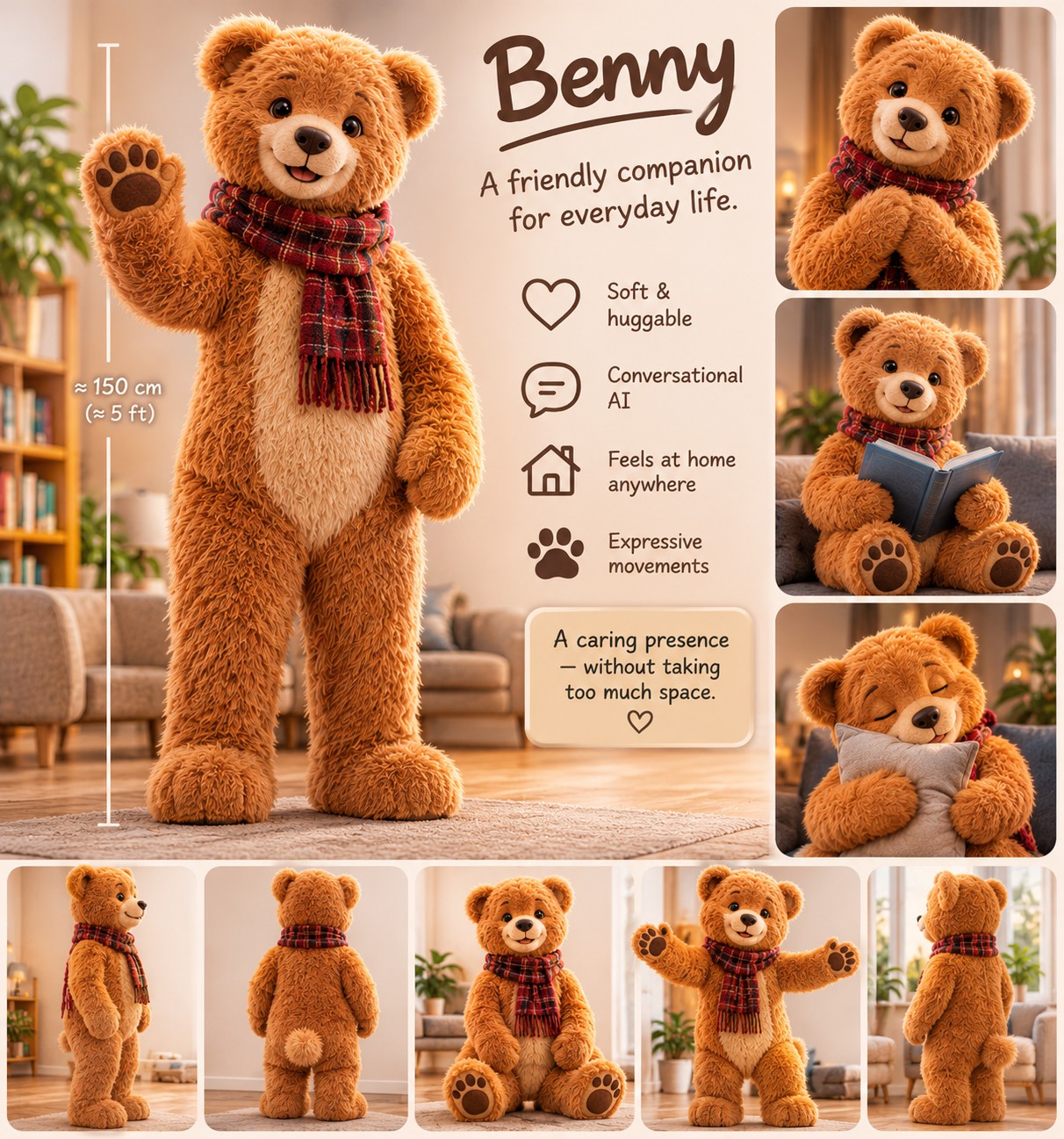
Figure 1.
commentComments
Click here for more information.
No Comments.
Cookies Notice
We use cookies to ensure that we give you the best experience on our website. By continuing to visit this site you agree to our use of cookies.
Click here for more information about the use of cookies on our website.
Click here for more information about the use of cookies on our website.