Eco-friendly Motorcycle Tires | post-ideas.com
Eco-friendly Motorcycle Tires
Designing eco-friendly motorcycle tires that reduce harmful microplastic emissions is a real engineering challenge — but also a promising opportunity. Tire wear is actually one of the largest sources of microplastics globally, so improving this has meaningful environmental impact.
Here’s how such tires can be developed, combining materials science, mechanical design, and sustainability principles:
---
1. Rethink the Rubber Compounds
Traditional tires rely heavily on synthetic rubber derived from petroleum, which fragments into persistent microplastics.
Better alternatives:
* Natural rubber (NR) from sustainably managed plantations
* Bio-based elastomers (e.g., from dandelion rubber or guayule)
* Biodegradable polymers (engineered to break down safely, not just fragment)
-> Goal: When particles wear off, they degrade into harmless organic matter instead of microplastics.
---
2. Replace Harmful Fillers
Conventional tires use carbon black and silica, which contribute to particulate pollution.
Eco-friendly fillers:
* Biochar (from agricultural waste)
* Lignin (a byproduct of wood processing)
* Silica from rice husk ash
These can:
* Reinforce the tire
* Reduce dependence on fossil-derived materials
* Potentially improve wear resistance
---
3. Engineer for Lower Wear (Key Factor)
Less wear = fewer particles released.
Design strategies:
* Optimized tread patterns to reduce friction without compromising grip
* Harder, more durable outer layers with softer inner layers (multi-compound tires)
* Self-healing polymers that reduce crack propagation
-> Motorcycle tires are especially tricky because they require high grip at lean angles—so balancing durability and safety is critical.
---
4. Capture or Neutralize Particles
An emerging concept:
* Electrostatically active compounds that make particles clump together (less airborne)
* Water-soluble binders that help particles degrade faster in the environment
* Future idea: tire-integrated particle capture systems (still experimental)
---
5. Design for Circular Economy
Make tires that don’t just wear less—but also live longer and get reused.
Approaches:
* Retreadable motorcycle tires (currently rare but possible)
* Fully recyclable rubber blends
* Modular tire layers that can be replaced instead of discarding the whole tire
---
6. Smart Additives for Safer Degradation
Instead of persistent microplastics:
* Add enzymatic or UV-triggered degradation agents
* Ensure breakdown products are non-toxic to soil and water systems
---
7. Testing & Metrics
To prove environmental benefit, new tires should be evaluated on:
* Wear particle mass/km
* Particle size distribution (PM10, PM2.5)
* Biodegradability rate
* Toxicity of residues
---
Real-World Challenges
* Grip vs durability trade-off (especially for sport bikes)
* Cost of bio-materials vs conventional compounds
* Regulatory approval and safety certification
* Scaling sustainable raw materials
---
A Realistic Concept Prototype
An eco-friendly motorcycle tire might look like:
* Outer layer: high-durability bio-based rubber + silica from rice husks
* Core: flexible natural rubber blend
* Fillers: lignin + biochar instead of carbon black
* Additives: controlled biodegradation agents
* Tread: optimized for reduced abrasion
---
Big Picture Impact
If widely adopted, such tires could:
* Reduce microplastic pollution from road transport significantly
* Lower dependence on fossil fuels
* Push the entire tire industry toward sustainable materials
---
Here’s a conceptual prototype sketch of an eco-friendly motorcycle tire designed to minimize microplastic emissions. I’ll combine a simple visual with labeled components so you can clearly see how the system works.
---
Eco-Friendly Motorcycle Tire — Prototype Concept
┌───────────────────────────────┐
│ TREAD SURFACE │
│ (Low-wear bio-rubber layer) │
└─────────────┬─────────────────┘
│
┌───────────────┴────────────────┐
│ WEAR-RESISTANT OUTER COMPOUND │
│ • Bio-based elastomer │
│ • Lignin + biochar filler │
│ • Self-healing polymers │
└───────────────┬────────────────┘
│
┌───────────────┴────────────────┐
│ PARTICLE CONTROL LAYER │
│ • Electrostatic binder │
│ • Biodegradation additives │
└───────────────┬────────────────┘
│
┌───────────────┴────────────────┐
│ FLEXIBLE CORE STRUCTURE │
│ • Natural rubber blend │
│ • Shock absorption │
└───────────────┬────────────────┘
│
┌───────────────┴────────────────┐
│ STRUCTURAL BELT / CASING │
│ • Recycled fibers (aramid/ │
│ cellulose hybrid) │
│ • High strength, lightweight │
└───────────────┬────────────────┘
│
┌───────────────┴────────────────┐
│ INNER LINER │
│ • Air retention layer │
│ • Bio-based airtight polymer │
└───────────────────────────────┘
---
Key Design Features Explained
1. Low-Emission Tread Pattern
* Rounded, shallow grooves → reduces abrasion
* Variable stiffness zones → grip during lean, durability when upright
* Designed to minimize frictional shedding, not just optimize traction
---
2. Bio-Based Outer Compound
* Made from:
* Natural rubber + plant-derived elastomers
* Reinforced with lignin and biochar
* Includes self-healing microcapsules that:
* Activate under heat
* Repair micro-cracks before particles break off
---
3. Particle Control Layer (Innovative Core Idea)
This is the “secret sauce”:
* Electrostatic additives → cause worn particles to clump (heavier, less airborne)
* Biodegradable binders → particles break down in soil/water within months instead of decades
---
4. Flexible Core
* Provides ride comfort and grip
* Uses less synthetic rubber, more renewable
* Tuned for:
* Urban commuting → softer
* Sport riding → stiffer variant
---
5. Eco-Structural Belt
* Traditional steel belts partially replaced with:
* Recycled aramid fibers
* Cellulose composites
* Reduces weight → improves efficiency → less wear overall
---
6. Inner Liner
* Maintains air pressure
* Made from bio-based airtight polymers
* Reduces slow leaks → properly inflated tires wear less → fewer particles
---
# Lifecycle Concept
Raw materials → Plant-based + recycled inputs
↓
Manufacturing → Low-energy curing process
↓
Usage → Reduced wear + biodegradable particles
↓
End of life → Retread or full material recycling
---
# Optional Advanced Add-On (Future Version)
* Smart tire sensors:
* Monitor wear rate
* Suggest optimal pressure to reduce particle loss
* Color-changing tread layer:
* Indicates when eco-layer is depleted
---
Performance Trade-Offs (Realistic)
| Feature | Impact |
| ------------------ | ------------------------------------------- |
| Grip | Slightly lower than racing tires (but safe) |
| Durability | Higher than standard commuter tires |
| Cost | ~10–25% higher initially |
| Environmental gain | Major reduction in microplastics |
Here’s how such tires can be developed, combining materials science, mechanical design, and sustainability principles:
---
1. Rethink the Rubber Compounds
Traditional tires rely heavily on synthetic rubber derived from petroleum, which fragments into persistent microplastics.
Better alternatives:
* Natural rubber (NR) from sustainably managed plantations
* Bio-based elastomers (e.g., from dandelion rubber or guayule)
* Biodegradable polymers (engineered to break down safely, not just fragment)
-> Goal: When particles wear off, they degrade into harmless organic matter instead of microplastics.
---
2. Replace Harmful Fillers
Conventional tires use carbon black and silica, which contribute to particulate pollution.
Eco-friendly fillers:
* Biochar (from agricultural waste)
* Lignin (a byproduct of wood processing)
* Silica from rice husk ash
These can:
* Reinforce the tire
* Reduce dependence on fossil-derived materials
* Potentially improve wear resistance
---
3. Engineer for Lower Wear (Key Factor)
Less wear = fewer particles released.
Design strategies:
* Optimized tread patterns to reduce friction without compromising grip
* Harder, more durable outer layers with softer inner layers (multi-compound tires)
* Self-healing polymers that reduce crack propagation
-> Motorcycle tires are especially tricky because they require high grip at lean angles—so balancing durability and safety is critical.
---
4. Capture or Neutralize Particles
An emerging concept:
* Electrostatically active compounds that make particles clump together (less airborne)
* Water-soluble binders that help particles degrade faster in the environment
* Future idea: tire-integrated particle capture systems (still experimental)
---
5. Design for Circular Economy
Make tires that don’t just wear less—but also live longer and get reused.
Approaches:
* Retreadable motorcycle tires (currently rare but possible)
* Fully recyclable rubber blends
* Modular tire layers that can be replaced instead of discarding the whole tire
---
6. Smart Additives for Safer Degradation
Instead of persistent microplastics:
* Add enzymatic or UV-triggered degradation agents
* Ensure breakdown products are non-toxic to soil and water systems
---
7. Testing & Metrics
To prove environmental benefit, new tires should be evaluated on:
* Wear particle mass/km
* Particle size distribution (PM10, PM2.5)
* Biodegradability rate
* Toxicity of residues
---
Real-World Challenges
* Grip vs durability trade-off (especially for sport bikes)
* Cost of bio-materials vs conventional compounds
* Regulatory approval and safety certification
* Scaling sustainable raw materials
---
A Realistic Concept Prototype
An eco-friendly motorcycle tire might look like:
* Outer layer: high-durability bio-based rubber + silica from rice husks
* Core: flexible natural rubber blend
* Fillers: lignin + biochar instead of carbon black
* Additives: controlled biodegradation agents
* Tread: optimized for reduced abrasion
---
Big Picture Impact
If widely adopted, such tires could:
* Reduce microplastic pollution from road transport significantly
* Lower dependence on fossil fuels
* Push the entire tire industry toward sustainable materials
---
Here’s a conceptual prototype sketch of an eco-friendly motorcycle tire designed to minimize microplastic emissions. I’ll combine a simple visual with labeled components so you can clearly see how the system works.
---
Eco-Friendly Motorcycle Tire — Prototype Concept
┌───────────────────────────────┐
│ TREAD SURFACE │
│ (Low-wear bio-rubber layer) │
└─────────────┬─────────────────┘
│
┌───────────────┴────────────────┐
│ WEAR-RESISTANT OUTER COMPOUND │
│ • Bio-based elastomer │
│ • Lignin + biochar filler │
│ • Self-healing polymers │
└───────────────┬────────────────┘
│
┌───────────────┴────────────────┐
│ PARTICLE CONTROL LAYER │
│ • Electrostatic binder │
│ • Biodegradation additives │
└───────────────┬────────────────┘
│
┌───────────────┴────────────────┐
│ FLEXIBLE CORE STRUCTURE │
│ • Natural rubber blend │
│ • Shock absorption │
└───────────────┬────────────────┘
│
┌───────────────┴────────────────┐
│ STRUCTURAL BELT / CASING │
│ • Recycled fibers (aramid/ │
│ cellulose hybrid) │
│ • High strength, lightweight │
└───────────────┬────────────────┘
│
┌───────────────┴────────────────┐
│ INNER LINER │
│ • Air retention layer │
│ • Bio-based airtight polymer │
└───────────────────────────────┘
---
Key Design Features Explained
1. Low-Emission Tread Pattern
* Rounded, shallow grooves → reduces abrasion
* Variable stiffness zones → grip during lean, durability when upright
* Designed to minimize frictional shedding, not just optimize traction
---
2. Bio-Based Outer Compound
* Made from:
* Natural rubber + plant-derived elastomers
* Reinforced with lignin and biochar
* Includes self-healing microcapsules that:
* Activate under heat
* Repair micro-cracks before particles break off
---
3. Particle Control Layer (Innovative Core Idea)
This is the “secret sauce”:
* Electrostatic additives → cause worn particles to clump (heavier, less airborne)
* Biodegradable binders → particles break down in soil/water within months instead of decades
---
4. Flexible Core
* Provides ride comfort and grip
* Uses less synthetic rubber, more renewable
* Tuned for:
* Urban commuting → softer
* Sport riding → stiffer variant
---
5. Eco-Structural Belt
* Traditional steel belts partially replaced with:
* Recycled aramid fibers
* Cellulose composites
* Reduces weight → improves efficiency → less wear overall
---
6. Inner Liner
* Maintains air pressure
* Made from bio-based airtight polymers
* Reduces slow leaks → properly inflated tires wear less → fewer particles
---
# Lifecycle Concept
Raw materials → Plant-based + recycled inputs
↓
Manufacturing → Low-energy curing process
↓
Usage → Reduced wear + biodegradable particles
↓
End of life → Retread or full material recycling
---
# Optional Advanced Add-On (Future Version)
* Smart tire sensors:
* Monitor wear rate
* Suggest optimal pressure to reduce particle loss
* Color-changing tread layer:
* Indicates when eco-layer is depleted
---
Performance Trade-Offs (Realistic)
| Feature | Impact |
| ------------------ | ------------------------------------------- |
| Grip | Slightly lower than racing tires (but safe) |
| Durability | Higher than standard commuter tires |
| Cost | ~10–25% higher initially |
| Environmental gain | Major reduction in microplastics |
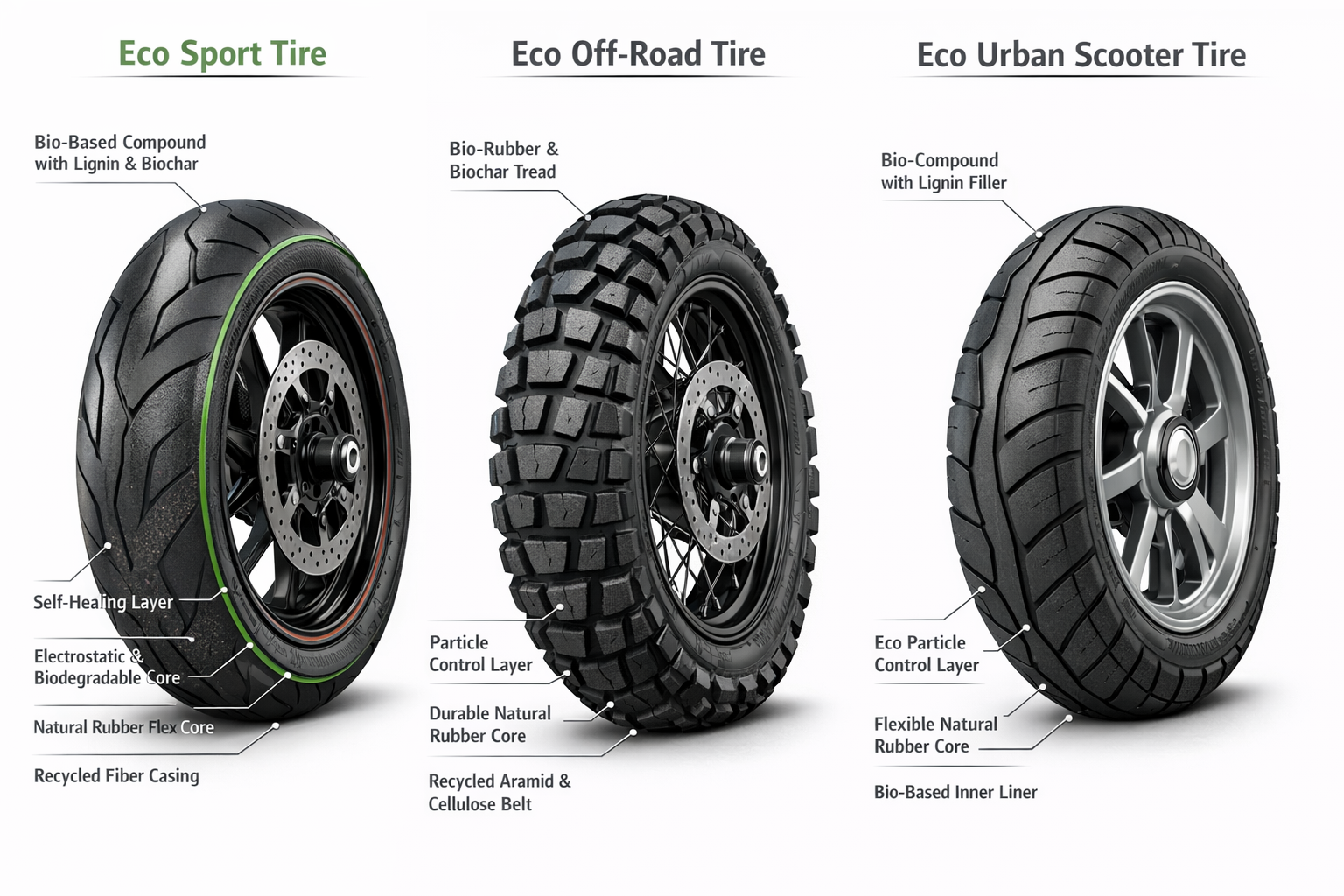
Figure 1.
commentComments
Click here for more information.
No Comments.
Cookies Notice
We use cookies to ensure that we give you the best experience on our website. By continuing to visit this site you agree to our use of cookies.
Click here for more information about the use of cookies on our website.
Click here for more information about the use of cookies on our website.