Mixed power grid | post-ideas.com
Mixed power grid
Here’s a structured concept for a Mixed Power Grid (AC Generation – DC Distribution Model) designed for modern energy needs.
Concept: Mixed Power Grid (AC-to-DC Hybrid Infrastructure)
---
1. Core Idea
Traditional grids generate and distribute alternating current (AC). However, most modern devices (LED lighting, computers, TVs, EV chargers, heat pumps, solar panels, batteries) internally operate on direct current (DC).
The Mixed Power Grid rethinks the architecture:
* Power plants generate AC (as they do today).
* Transmission remains AC or HVDC depending on distance.
* Regional distribution centers convert AC → DC.
* Homes and buildings receive DC as the primary supply.
* AC outlets remain optional for legacy appliances.
---
2. System Architecture
A. Generation Layer (AC)
* Conventional power plants (coal, gas, nuclear, hydro)
* Wind turbines (AC output)
* Large-scale solar farms (DC → inverted to AC for grid integration)
AC remains ideal for:
* Rotating machinery
* Synchronous grid stability
* Existing infrastructure compatibility
B. Transmission Layer
Two options depending on distance:
1. High-Voltage AC (HVAC) – regional networks
2. High-Voltage DC (HVDC) – long-distance transmission
HVDC is already used in projects like:
* ABB HVDC systems
* Siemens Energy HVDC corridors
C. Conversion & Distribution Layer (The Key Innovation)
At regional substations:
* Incoming AC is rectified to medium-voltage DC (MVDC).
* Smart solid-state transformers regulate voltage.
* Local battery buffers stabilize the DC bus.
From there:
* DC feeders supply neighborhoods.
* Buildings receive standardized low-voltage DC (e.g., 350V–400V DC).
D. Residential & Commercial Layer
Homes operate on:
1. Main DC Bus
* 380V DC backbone (similar to commercial data centers)
* Direct connection to:
* LED lighting
* Electronics
* EV chargers
* Heat pumps
* Battery storage
* Rooftop solar panels
2. Local Inverter Module
* Small AC inverter for:
* Legacy AC appliances
* Motors not yet DC-compatible
3. Why Shift to DC at the Consumer Level?
Efficiency Gains
Today’s energy flow:
AC grid → DC conversion (device power supply) → DC use
Each conversion loses ~5–20%.
In a DC home:
* Solar panels produce DC.
* Batteries store DC.
* Electronics use DC.
* EVs charge DC.
* Fewer conversion stages → Higher overall efficiency.
---
Renewable Integration
Solar (DC) integrates natively:
* No inverter required at every house.
* Easier microgrid operation.
* More stable with local battery storage.
---
EV Optimization
Electric vehicles use DC batteries.
Current setup:
AC home → EV charger → AC/DC conversion → Battery
In DC grid:
DC home → direct DC fast charging → Higher efficiency.
---
Microgrid & Resilience
Neighborhood DC grids can:
* Island during outages.
* Operate independently with local storage.
* Reduce cascading failures.
---
4. Technical Standards Proposal
| Layer | Voltage Level | Notes |
| ------------ | ------------- | -------------------- |
| Transmission | ±320kV HVDC | Long-distance |
| Regional DC | 10–20kV MVDC | Substation level |
| Neighborhood | 1–3kV DC | Feeder lines |
| Building | 380V DC | Main building bus |
| Appliance | 24–48V DC | Low-voltage circuits |
---
5. Smart Grid Intelligence
Mixed Power Grid requires:
* Solid-state transformers
* Bidirectional power electronics
* AI-based load balancing
* Real-time DC fault detection
* Fast electronic breakers (since DC doesn’t self-extinguish like AC)
---
6. Challenges
DC Circuit Protection
DC arcs are harder to interrupt. Solution:
* Solid-state breakers
* Arc-fault detection
* Fast isolation switches
Legacy Infrastructure
* Most homes are wired for AC.
* Transition would require phased adoption.
Standardization
Global agreement needed (IEC / IEEE).
---
7. Phased Implementation Strategy
Phase 1 – Industrial & Data Centers
(Already partially DC internally.)
Phase 2 – New Residential Developments
* DC-ready homes
* Integrated solar + battery
Phase 3 – Urban Retrofitting
* Replace neighborhood substations
* Hybrid AC/DC home panels
---
8. Potential Impact
Efficiency: 5–15% system-wide efficiency improvement.
Emissions: Lower losses → less generation needed.
Urban Design: Buildings become energy nodes, not passive consumers.
Future-Ready Supports:
* Vehicle-to-grid (V2G)
* Smart homes
* Local storage economies
---
Vision: The DC-Optimized Future
The Mixed Power Grid keeps:
* AC where it works best (generation & legacy)
* DC where it makes more sense (consumption & storage)
It bridges the 20th-century AC infrastructure with 21st-century DC devices.
Below is a conceptual system diagram and architectural walkthrough of the Mixed Power Grid (AC Generation → DC Distribution).
---
Mixed Power Grid – Conceptual System Diagram
┌─────────────────────────────┐
│ POWER PLANTS │
│ (AC Generation 50/60 Hz) │
└──────────────┬──────────────┘
│
▼
┌─────────────────────────────┐
│ HIGH VOLTAGE GRID │
│ HVAC or HVDC Transmission │
└──────────────┬──────────────┘
│
▼
┌─────────────────────────────┐
│ REGIONAL CONVERSION HUB │
│ AC → MVDC Rectification │
│ + Grid Stabilization │
│ + Battery Buffer │
└──────────────┬──────────────┘
│
▼
┌─────────────────────────────┐
│ NEIGHBORHOOD DC FEEDERS │
│ 1–3 kV DC Lines │
└──────────────┬──────────────┘
│
▼
┌─────────────────────────────┐
│ BUILDING DC PANEL │
│ 380V DC Main Bus │
│ + Local Inverter (AC) │
│ + Battery + Solar │
└──────────────┬──────────────┘
│
▼
┌─────────────────────────────┐
│ END DEVICES │
│ LED, EV, Electronics, HP │
│ (Native DC Load) │
└─────────────────────────────┘
---
Layer-by-Layer Functional Breakdown
Generation Layer (Unchanged Core)
* AC generation from turbines (thermal, hydro, wind).
* Keeps synchronous grid stability model.
* Compatible with current infrastructure worldwide.
This maintains compatibility with existing grids such as those operated by organizations like National Grid or PJM Interconnection.
---
Transmission Layer (Flexible)
Two possible configurations:
A. HVAC (Short to Medium Distance)
* Existing infrastructure reused.
* Lower conversion cost.
B. HVDC (Long Distance / High Efficiency)
Used in modern interconnectors such as:
* Hitachi Energy HVDC Light systems
* GE Vernova HVDC solutions
HVDC reduces:
* Reactive power losses
* Synchronization constraints between regions
---
Regional Conversion Hub (Core Innovation Node)
This replaces traditional AC-only substations.
Components:
1. Solid-State Rectifier Banks
* Convert high-voltage AC → medium-voltage DC (10–20kV)
* Modular multilevel converters (MMC topology)
2. Battery Buffer Storage
* Lithium-ion or sodium-ion grid-scale batteries
* Smooth load spikes
* Provide short-term resilience
3. Smart Grid Controller
* Real-time load balancing
* Fault detection
* Predictive demand response
* AI-based voltage regulation
4. Solid-State DC Breakers
Because DC lacks zero-crossing:
* Fast electronic isolation (<5 ms)
* Arc suppression chambers
---
Neighborhood DC Feeder Network
Instead of 230/120V AC:
* 1–3kV DC trunk lines
* Smaller transformers replaced by DC/DC converters
* Underground insulated DC cables
Advantages:
* Lower line losses
* No reactive power
* Smaller conductor cross-section for same power
---
Building-Level DC Infrastructure
Building DC Panel Design
Primary Bus: 380V DC
Why 380V?
* Already used in commercial data centers
* Efficient for EV charging and heat pumps
* Lower current → thinner wiring
Secondary Rails:
* 48V DC (IT equipment, LED lighting)
* 24V DC (controls & smart systems)
---
Appliance-Level Architecture
Modern devices already convert AC → DC internally.
Examples:
* Laptop power supplies
* LED drivers
* EV chargers
* Variable-speed heat pumps
Manufacturers like Tesla, Inc. or Schneider Electric already design systems heavily dependent on DC power electronics.
Under this model:
* Conversion stage is eliminated.
* Devices connect directly to regulated DC.
---
Bidirectional Energy Flow
This grid is inherently bidirectional.
Homes can:
* Export solar DC directly to the neighborhood bus.
* Feed battery storage back to the grid.
* Participate in microgrid islanding.
This enables:
* Peer-to-peer energy trading
* Vehicle-to-grid (V2G)
* Autonomous energy clusters
---
Control & Protection Architecture
Because DC behaves differently from AC:
Protection Strategy
* Solid-state breakers at every node
* Fast current sensing (<1ms)
* Zonal isolation design
* Fault-tolerant ring topology feeders
Digital Twin Monitoring
Each conversion hub maintains:
* Thermal monitoring
* Harmonic distortion analysis
* Load forecasting models
---
Example Urban Deployment Model
City District Rollout
1. Replace traditional substation with DC hub.
2. Install dual AC/DC service panels in buildings.
3. Offer incentives for DC-compatible appliances.
4. Gradually phase out low-voltage AC distribution.
---
Estimated Efficiency Gains (System-Wide)
| Stage Removed | Typical Loss | Saved |
| ----------------------- | ------------ | ---------- |
| Device AC/DC conversion | 5–10% | Eliminated |
| Solar inverter stage | 3–5% | Reduced |
| EV charger conversion | 5–8% | Reduced |
| Reactive power losses | 2–4% | Eliminated |
Total potential improvement: 8–15%
---
Strategic Outcome
The Mixed Power Grid:
* Preserves AC where physics favors it (generation & legacy).
* Uses DC where electronics dominate (consumption & storage).
* Creates a natural bridge toward renewable-heavy grids.
* Reduces systemic inefficiencies embedded in 20th-century infrastructure.
---
Here are the key benefits of the Mixed Power Grid (AC generation → DC distribution):
1. Higher System Efficiency
Fewer Energy Conversions
Most modern devices internally convert AC → DC.
With DC distribution:
* Solar panels (DC) → directly usable
* Batteries (DC) → no inversion needed
* EV charging → direct DC
* Electronics → native DC supply
Result:
Eliminates multiple 5–10% conversion losses per device.
Estimated system-wide gain: 8–15%
---
2. Better Renewable Energy Integration
Solar power is naturally DC.
In today’s grid:
Solar → DC → inverter → AC grid → device → DC again
In the mixed grid:
Solar → DC → DC bus → device
Benefits:
* Fewer inverters
* Lower installation cost
* Higher efficiency
* Easier microgrid design
---
3. More Efficient EV Charging
EV batteries are DC.
Traditional flow:
AC → onboard charger → DC → battery
Mixed grid:
DC → battery (direct high-efficiency charging)
Benefits:
* Faster charging
* Reduced heat losses
* Smaller onboard chargers
* Better vehicle-to-grid (V2G) capability
---
4. Reduced Transmission & Distribution Losses
DC distribution eliminates:
* Reactive power losses
* Phase imbalance issues
* Skin effect inefficiencies (reduced in DC)
* Synchronization constraints
Result:
* Lower line losses
* Better cable utilization
* Potentially smaller conductor sizes
---
5. Natural Microgrid Compatibility
Neighborhood DC grids can:
* Island during outages
* Operate with local solar + batteries
* Prevent cascading failures
Improves resilience during:
* Storms
* Grid instability
* Peak demand events
---
6. Smarter Load Control
DC grids rely on power electronics, enabling:
* Real-time voltage regulation
* Fast electronic switching
* AI-based demand balancing
* Precise fault isolation
More flexible than purely mechanical AC systems.
---
7. Improved Power Quality
Benefits include:
* No frequency instability at the consumer level
* No phase mismatch problems
* Reduced harmonic distortion
* Stable voltage rails for sensitive electronics
Especially valuable for:
* Data centers
* Medical facilities
* Industrial automation
---
8. Future-Ready Infrastructure
Supports emerging technologies:
* Vehicle-to-grid (V2G)
* Home battery ecosystems
* Peer-to-peer energy trading
* Smart buildings
* DC-based LED lighting networks
* Heat pumps and inverter-driven appliances
Manufacturers like Schneider Electric and Tesla, Inc. already design ecosystems centered around DC electronics.
---
9. Long-Term Cost Reduction
Although initial infrastructure upgrades are required:
Long-term savings come from:
* Reduced conversion hardware
* Lower operational losses
* Smaller EV onboard chargers
* Fewer distributed inverters
* Lower maintenance of reactive compensation systems
---
10. Lower Carbon Footprint
Higher efficiency means:
* Less energy generation required
* Reduced peak load stress
* Better renewable penetration
Even a 10% grid efficiency gain could significantly reduce national energy demand.
---
11. Simplified Integration of Storage
Since batteries operate in DC:
* Grid-scale storage integrates more naturally
* Home batteries connect directly
* Faster response times for frequency support (via converters)
---
12. Scalability for Urban Growth
DC neighborhood clusters allow:
* Modular expansion
* Localized capacity upgrades
* Reduced stress on central grid nodes
Cities can grow in “energy cells” rather than relying solely on massive centralized upgrades.
---
STRATEGIC SUMMARY
The Mixed Power Grid:
* Keeps AC where it is physically optimal (generation & long-distance transmission).
* Uses DC where electronics dominate (storage, EVs, devices).
* Reduces systemic inefficiencies inherited from 20th-century infrastructure.
* Aligns the grid with the reality that most modern loads are DC internally.
Concept: Mixed Power Grid (AC-to-DC Hybrid Infrastructure)
---
1. Core Idea
Traditional grids generate and distribute alternating current (AC). However, most modern devices (LED lighting, computers, TVs, EV chargers, heat pumps, solar panels, batteries) internally operate on direct current (DC).
The Mixed Power Grid rethinks the architecture:
* Power plants generate AC (as they do today).
* Transmission remains AC or HVDC depending on distance.
* Regional distribution centers convert AC → DC.
* Homes and buildings receive DC as the primary supply.
* AC outlets remain optional for legacy appliances.
---
2. System Architecture
A. Generation Layer (AC)
* Conventional power plants (coal, gas, nuclear, hydro)
* Wind turbines (AC output)
* Large-scale solar farms (DC → inverted to AC for grid integration)
AC remains ideal for:
* Rotating machinery
* Synchronous grid stability
* Existing infrastructure compatibility
B. Transmission Layer
Two options depending on distance:
1. High-Voltage AC (HVAC) – regional networks
2. High-Voltage DC (HVDC) – long-distance transmission
HVDC is already used in projects like:
* ABB HVDC systems
* Siemens Energy HVDC corridors
C. Conversion & Distribution Layer (The Key Innovation)
At regional substations:
* Incoming AC is rectified to medium-voltage DC (MVDC).
* Smart solid-state transformers regulate voltage.
* Local battery buffers stabilize the DC bus.
From there:
* DC feeders supply neighborhoods.
* Buildings receive standardized low-voltage DC (e.g., 350V–400V DC).
D. Residential & Commercial Layer
Homes operate on:
1. Main DC Bus
* 380V DC backbone (similar to commercial data centers)
* Direct connection to:
* LED lighting
* Electronics
* EV chargers
* Heat pumps
* Battery storage
* Rooftop solar panels
2. Local Inverter Module
* Small AC inverter for:
* Legacy AC appliances
* Motors not yet DC-compatible
3. Why Shift to DC at the Consumer Level?
Efficiency Gains
Today’s energy flow:
AC grid → DC conversion (device power supply) → DC use
Each conversion loses ~5–20%.
In a DC home:
* Solar panels produce DC.
* Batteries store DC.
* Electronics use DC.
* EVs charge DC.
* Fewer conversion stages → Higher overall efficiency.
---
Renewable Integration
Solar (DC) integrates natively:
* No inverter required at every house.
* Easier microgrid operation.
* More stable with local battery storage.
---
EV Optimization
Electric vehicles use DC batteries.
Current setup:
AC home → EV charger → AC/DC conversion → Battery
In DC grid:
DC home → direct DC fast charging → Higher efficiency.
---
Microgrid & Resilience
Neighborhood DC grids can:
* Island during outages.
* Operate independently with local storage.
* Reduce cascading failures.
---
4. Technical Standards Proposal
| Layer | Voltage Level | Notes |
| ------------ | ------------- | -------------------- |
| Transmission | ±320kV HVDC | Long-distance |
| Regional DC | 10–20kV MVDC | Substation level |
| Neighborhood | 1–3kV DC | Feeder lines |
| Building | 380V DC | Main building bus |
| Appliance | 24–48V DC | Low-voltage circuits |
---
5. Smart Grid Intelligence
Mixed Power Grid requires:
* Solid-state transformers
* Bidirectional power electronics
* AI-based load balancing
* Real-time DC fault detection
* Fast electronic breakers (since DC doesn’t self-extinguish like AC)
---
6. Challenges
DC Circuit Protection
DC arcs are harder to interrupt. Solution:
* Solid-state breakers
* Arc-fault detection
* Fast isolation switches
Legacy Infrastructure
* Most homes are wired for AC.
* Transition would require phased adoption.
Standardization
Global agreement needed (IEC / IEEE).
---
7. Phased Implementation Strategy
Phase 1 – Industrial & Data Centers
(Already partially DC internally.)
Phase 2 – New Residential Developments
* DC-ready homes
* Integrated solar + battery
Phase 3 – Urban Retrofitting
* Replace neighborhood substations
* Hybrid AC/DC home panels
---
8. Potential Impact
Efficiency: 5–15% system-wide efficiency improvement.
Emissions: Lower losses → less generation needed.
Urban Design: Buildings become energy nodes, not passive consumers.
Future-Ready Supports:
* Vehicle-to-grid (V2G)
* Smart homes
* Local storage economies
---
Vision: The DC-Optimized Future
The Mixed Power Grid keeps:
* AC where it works best (generation & legacy)
* DC where it makes more sense (consumption & storage)
It bridges the 20th-century AC infrastructure with 21st-century DC devices.
Below is a conceptual system diagram and architectural walkthrough of the Mixed Power Grid (AC Generation → DC Distribution).
---
Mixed Power Grid – Conceptual System Diagram
┌─────────────────────────────┐
│ POWER PLANTS │
│ (AC Generation 50/60 Hz) │
└──────────────┬──────────────┘
│
▼
┌─────────────────────────────┐
│ HIGH VOLTAGE GRID │
│ HVAC or HVDC Transmission │
└──────────────┬──────────────┘
│
▼
┌─────────────────────────────┐
│ REGIONAL CONVERSION HUB │
│ AC → MVDC Rectification │
│ + Grid Stabilization │
│ + Battery Buffer │
└──────────────┬──────────────┘
│
▼
┌─────────────────────────────┐
│ NEIGHBORHOOD DC FEEDERS │
│ 1–3 kV DC Lines │
└──────────────┬──────────────┘
│
▼
┌─────────────────────────────┐
│ BUILDING DC PANEL │
│ 380V DC Main Bus │
│ + Local Inverter (AC) │
│ + Battery + Solar │
└──────────────┬──────────────┘
│
▼
┌─────────────────────────────┐
│ END DEVICES │
│ LED, EV, Electronics, HP │
│ (Native DC Load) │
└─────────────────────────────┘
---
Layer-by-Layer Functional Breakdown
Generation Layer (Unchanged Core)
* AC generation from turbines (thermal, hydro, wind).
* Keeps synchronous grid stability model.
* Compatible with current infrastructure worldwide.
This maintains compatibility with existing grids such as those operated by organizations like National Grid or PJM Interconnection.
---
Transmission Layer (Flexible)
Two possible configurations:
A. HVAC (Short to Medium Distance)
* Existing infrastructure reused.
* Lower conversion cost.
B. HVDC (Long Distance / High Efficiency)
Used in modern interconnectors such as:
* Hitachi Energy HVDC Light systems
* GE Vernova HVDC solutions
HVDC reduces:
* Reactive power losses
* Synchronization constraints between regions
---
Regional Conversion Hub (Core Innovation Node)
This replaces traditional AC-only substations.
Components:
1. Solid-State Rectifier Banks
* Convert high-voltage AC → medium-voltage DC (10–20kV)
* Modular multilevel converters (MMC topology)
2. Battery Buffer Storage
* Lithium-ion or sodium-ion grid-scale batteries
* Smooth load spikes
* Provide short-term resilience
3. Smart Grid Controller
* Real-time load balancing
* Fault detection
* Predictive demand response
* AI-based voltage regulation
4. Solid-State DC Breakers
Because DC lacks zero-crossing:
* Fast electronic isolation (<5 ms)
* Arc suppression chambers
---
Neighborhood DC Feeder Network
Instead of 230/120V AC:
* 1–3kV DC trunk lines
* Smaller transformers replaced by DC/DC converters
* Underground insulated DC cables
Advantages:
* Lower line losses
* No reactive power
* Smaller conductor cross-section for same power
---
Building-Level DC Infrastructure
Building DC Panel Design
Primary Bus: 380V DC
Why 380V?
* Already used in commercial data centers
* Efficient for EV charging and heat pumps
* Lower current → thinner wiring
Secondary Rails:
* 48V DC (IT equipment, LED lighting)
* 24V DC (controls & smart systems)
---
Appliance-Level Architecture
Modern devices already convert AC → DC internally.
Examples:
* Laptop power supplies
* LED drivers
* EV chargers
* Variable-speed heat pumps
Manufacturers like Tesla, Inc. or Schneider Electric already design systems heavily dependent on DC power electronics.
Under this model:
* Conversion stage is eliminated.
* Devices connect directly to regulated DC.
---
Bidirectional Energy Flow
This grid is inherently bidirectional.
Homes can:
* Export solar DC directly to the neighborhood bus.
* Feed battery storage back to the grid.
* Participate in microgrid islanding.
This enables:
* Peer-to-peer energy trading
* Vehicle-to-grid (V2G)
* Autonomous energy clusters
---
Control & Protection Architecture
Because DC behaves differently from AC:
Protection Strategy
* Solid-state breakers at every node
* Fast current sensing (<1ms)
* Zonal isolation design
* Fault-tolerant ring topology feeders
Digital Twin Monitoring
Each conversion hub maintains:
* Thermal monitoring
* Harmonic distortion analysis
* Load forecasting models
---
Example Urban Deployment Model
City District Rollout
1. Replace traditional substation with DC hub.
2. Install dual AC/DC service panels in buildings.
3. Offer incentives for DC-compatible appliances.
4. Gradually phase out low-voltage AC distribution.
---
Estimated Efficiency Gains (System-Wide)
| Stage Removed | Typical Loss | Saved |
| ----------------------- | ------------ | ---------- |
| Device AC/DC conversion | 5–10% | Eliminated |
| Solar inverter stage | 3–5% | Reduced |
| EV charger conversion | 5–8% | Reduced |
| Reactive power losses | 2–4% | Eliminated |
Total potential improvement: 8–15%
---
Strategic Outcome
The Mixed Power Grid:
* Preserves AC where physics favors it (generation & legacy).
* Uses DC where electronics dominate (consumption & storage).
* Creates a natural bridge toward renewable-heavy grids.
* Reduces systemic inefficiencies embedded in 20th-century infrastructure.
---
Here are the key benefits of the Mixed Power Grid (AC generation → DC distribution):
1. Higher System Efficiency
Fewer Energy Conversions
Most modern devices internally convert AC → DC.
With DC distribution:
* Solar panels (DC) → directly usable
* Batteries (DC) → no inversion needed
* EV charging → direct DC
* Electronics → native DC supply
Result:
Eliminates multiple 5–10% conversion losses per device.
Estimated system-wide gain: 8–15%
---
2. Better Renewable Energy Integration
Solar power is naturally DC.
In today’s grid:
Solar → DC → inverter → AC grid → device → DC again
In the mixed grid:
Solar → DC → DC bus → device
Benefits:
* Fewer inverters
* Lower installation cost
* Higher efficiency
* Easier microgrid design
---
3. More Efficient EV Charging
EV batteries are DC.
Traditional flow:
AC → onboard charger → DC → battery
Mixed grid:
DC → battery (direct high-efficiency charging)
Benefits:
* Faster charging
* Reduced heat losses
* Smaller onboard chargers
* Better vehicle-to-grid (V2G) capability
---
4. Reduced Transmission & Distribution Losses
DC distribution eliminates:
* Reactive power losses
* Phase imbalance issues
* Skin effect inefficiencies (reduced in DC)
* Synchronization constraints
Result:
* Lower line losses
* Better cable utilization
* Potentially smaller conductor sizes
---
5. Natural Microgrid Compatibility
Neighborhood DC grids can:
* Island during outages
* Operate with local solar + batteries
* Prevent cascading failures
Improves resilience during:
* Storms
* Grid instability
* Peak demand events
---
6. Smarter Load Control
DC grids rely on power electronics, enabling:
* Real-time voltage regulation
* Fast electronic switching
* AI-based demand balancing
* Precise fault isolation
More flexible than purely mechanical AC systems.
---
7. Improved Power Quality
Benefits include:
* No frequency instability at the consumer level
* No phase mismatch problems
* Reduced harmonic distortion
* Stable voltage rails for sensitive electronics
Especially valuable for:
* Data centers
* Medical facilities
* Industrial automation
---
8. Future-Ready Infrastructure
Supports emerging technologies:
* Vehicle-to-grid (V2G)
* Home battery ecosystems
* Peer-to-peer energy trading
* Smart buildings
* DC-based LED lighting networks
* Heat pumps and inverter-driven appliances
Manufacturers like Schneider Electric and Tesla, Inc. already design ecosystems centered around DC electronics.
---
9. Long-Term Cost Reduction
Although initial infrastructure upgrades are required:
Long-term savings come from:
* Reduced conversion hardware
* Lower operational losses
* Smaller EV onboard chargers
* Fewer distributed inverters
* Lower maintenance of reactive compensation systems
---
10. Lower Carbon Footprint
Higher efficiency means:
* Less energy generation required
* Reduced peak load stress
* Better renewable penetration
Even a 10% grid efficiency gain could significantly reduce national energy demand.
---
11. Simplified Integration of Storage
Since batteries operate in DC:
* Grid-scale storage integrates more naturally
* Home batteries connect directly
* Faster response times for frequency support (via converters)
---
12. Scalability for Urban Growth
DC neighborhood clusters allow:
* Modular expansion
* Localized capacity upgrades
* Reduced stress on central grid nodes
Cities can grow in “energy cells” rather than relying solely on massive centralized upgrades.
---
STRATEGIC SUMMARY
The Mixed Power Grid:
* Keeps AC where it is physically optimal (generation & long-distance transmission).
* Uses DC where electronics dominate (storage, EVs, devices).
* Reduces systemic inefficiencies inherited from 20th-century infrastructure.
* Aligns the grid with the reality that most modern loads are DC internally.
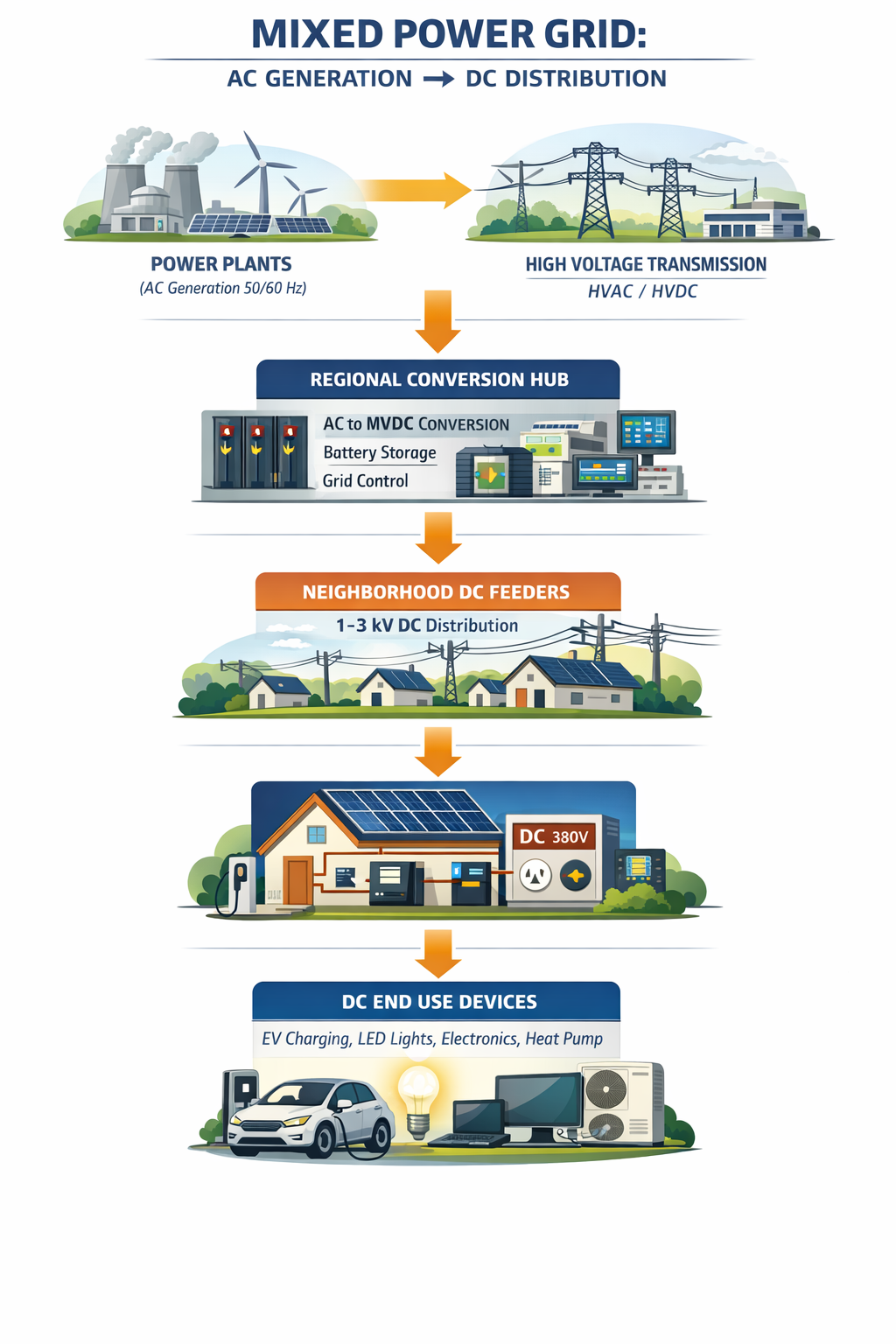
Figure 1.
commentComments
Click here for more information.
No Comments.
Cookies Notice
We use cookies to ensure that we give you the best experience on our website. By continuing to visit this site you agree to our use of cookies.
Click here for more information about the use of cookies on our website.
Click here for more information about the use of cookies on our website.